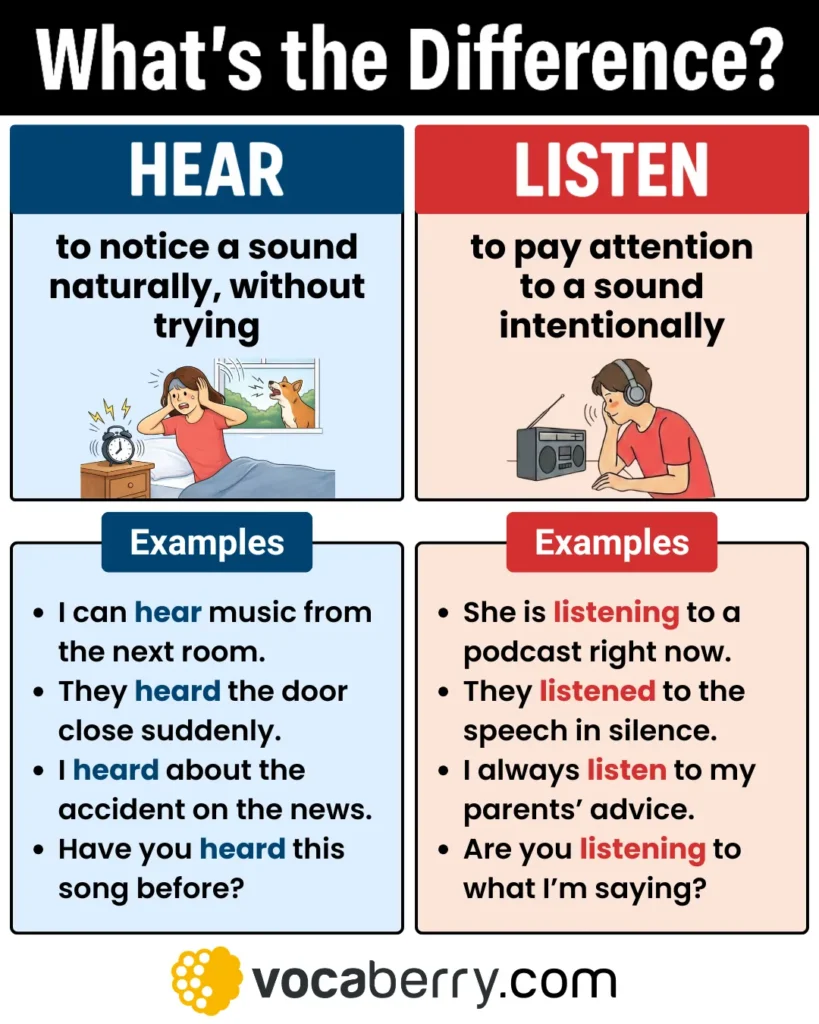
Many English learners confuse hear and listen because both verbs are related to sound. However, they do not mean the same thing. Hear happens naturally when a sound reaches your ears, while listen requires attention and effort.
In this article, you’ll learn the difference between hear and listen, their meanings, grammar structures, and how to use them correctly with clear examples.
What Does Hear Mean?
The verb hear means to notice or become aware of a sound using your ears. It usually happens naturally and without effort. If a sound reaches your ears, you hear it even if you are not trying. Hearing is automatic, and you do not decide to do it. In grammar, hear is followed directly by an object and does not use “to.” It can also be followed by an object plus a base verb or an -ing form.
Structure:
- hear + object
- hear + object + verb (base form or -ing)
Examples:
- I hear music from the next room.
- We heard the door close.
- They heard someone calling for help.
What Does Listen Mean?
The verb listen means to pay attention to a sound. Unlike hear, listening requires effort and focus. You choose to focus on what you are hearing, so it is an active action. In grammar, listen is usually followed by “to” before the object. It is not used directly with an object without “to.”
Structure:
- listen to + object
Examples:
- I listen to music every evening.
- She listened to the teacher carefully.
- We are listening to the radio.
Difference Between Hear and Listen
The main difference between hear and listen is effort and attention. Hear happens naturally and automatically when a sound reaches your ears. You do not choose to hear something; it simply happens. Listen, on the other hand, means to actively pay attention to a sound. It requires focus.
There is also a grammar difference. Hear is followed directly by an object. Listen is usually followed by to + object.
Structure:
- hear + object
- listen to + object
Examples:
- I heard the music.
- I listened to the music.
- She heard him speaking.
- She listened to him speaking.
Example Sentences Using Hear and Listen
These examples show how hear and listen are used in different situations in everyday English.
Example Sentences with Hear
- I heard a strange noise outside last night.
- She heard her name from across the room.
- We heard the baby crying upstairs.
- Did you hear what he said?
- I can hear music coming from the next apartment.
- He heard the door close behind him.
- They heard someone knocking at the window.
- I heard about the accident on the news.
- She has never heard that song before.
- We were surprised to hear the results.
Example Sentences with Listen
- I listen to music while I study.
- She listened carefully to the instructions.
- Please listen to me for a moment.
- We listened to the teacher explain the lesson.
- He listens to podcasts every morning.
- They were listening to the rain outside.
- I always listen to my parents’ advice.
- She stopped talking and listened closely.
- Are you listening to what I’m saying?
- He listened to the whole story without interrupting.