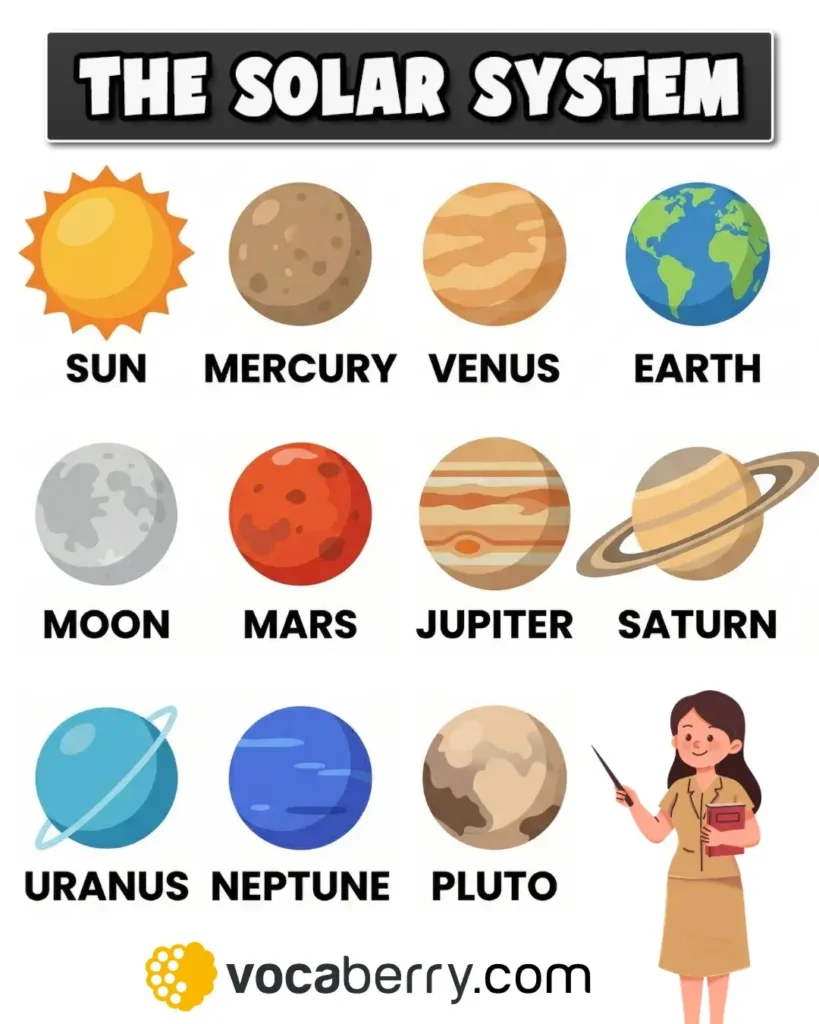
The solar system includes the Sun and all the planets and objects that move around it. The Sun is at the center, and the planets travel around it in paths called orbits. In our solar system, there are eight main planets, each different in size, composition, and appearance.
In this article, you’ll learn the planet names in English, simple explanations of each planet, the types of planets, and useful solar system vocabulary.
The Solar System
The solar system includes the Sun and all objects that orbit around it. The Sun is a star located at the center of the system, and its gravity keeps the planets moving in their paths, called orbits.
Our solar system has eight main planets: Mercury, Venus, Earth, Mars, Jupiter, Saturn, Uranus, and Neptune. Scientists often divide these planets into two main groups based on their composition and distance from the Sun.
Inner Planets
The inner planets are the planets closest to the Sun and are also known as rocky planets because they have solid surfaces made of rock and metal. These planets are Mercury, Venus, Earth, and Mars.
Outer Planets
The outer planets are much farther from the Sun and are much larger. They are mostly made of gas or icy materials. The outer planets are Jupiter, Saturn, Uranus, and Neptune.
Planet Names in English
Below are the planet names in English, along with simple explanations of each planet in the solar system.
Mercury
Mercury is the closest planet to the Sun and also the smallest planet in the solar system. It has a rocky surface that is covered with many craters, similar to the Moon.
Because Mercury has almost no atmosphere, it cannot keep heat. As a result, temperatures on the planet change a lot, becoming extremely hot during the day and very cold at night. A year on Mercury lasts only 88 Earth days, making it the shortest year of all the planets.
Venus
Venus is the second planet from the Sun and is often called Earth’s twin because it is similar in size and structure to Earth. However, the environment on Venus is very different from our planet.
Venus has a very thick atmosphere made mostly of carbon dioxide. This atmosphere traps heat and creates a strong greenhouse effect, making Venus the hottest planet in the solar system. It is also one of the brightest objects in the night sky, often called the Morning Star or Evening Star.
Earth
Earth is the third planet from the Sun and the only planet known to support life. It has liquid water, a breathable atmosphere, and temperatures that allow plants, animals, and humans to live.
About 71% of Earth’s surface is covered by water, mainly oceans. Earth also has one natural satellite called the Moon, which orbits the planet and influences ocean tides.
Mars
Mars is the fourth planet from the Sun and is commonly known as the Red Planet. Its reddish color comes from iron oxide, also known as rust, on its surface.
Mars has many interesting features, including large volcanoes, deep valleys, and polar ice caps. Scientists study Mars carefully because there is evidence that water may have existed there in the past.
Jupiter
Jupiter is the largest planet in the solar system. It is a gas giant, which means it does not have a solid surface like Earth and is mostly made of hydrogen and helium.
One of Jupiter’s most famous features is the Great Red Spot, a giant storm that has been active for more than 300 years. Jupiter also has many moons, including the four large moons discovered by Galileo.
Saturn
Saturn is the sixth planet from the Sun and the second-largest planet in the solar system. It is well known for its beautiful rings, which are made of ice, rock, and dust.
Like Jupiter, Saturn is a gas giant with a thick atmosphere. The planet has many moons, and its largest moon, Titan, is one of the most interesting moons in the solar system.
Uranus
Uranus is the seventh planet from the Sun and is classified as an ice giant. It has a pale blue color because of methane gas in its atmosphere.
A unique feature of Uranus is that it rotates on its side, unlike most other planets. This unusual tilt causes extreme seasonal changes as the planet moves around the Sun.
Neptune
Neptune is the eighth and farthest planet from the Sun in our solar system. It is another ice giant with a deep blue color.
Neptune is famous for having the strongest winds in the solar system, with speeds that can reach more than 2,000 kilometers per hour. Because it is so far from the Sun, Neptune is also very cold.
Pluto
Pluto was once considered the ninth planet in the solar system. However, in 2006 scientists reclassified it as a dwarf planet.
Although Pluto is smaller than the other planets, it is still an interesting object in space. Many educational charts still include Pluto when teaching students about the solar system.
Types of Planets
These terms are commonly used to describe and classify planets in the solar system.
Rocky Planets
Rocky planets have a solid surface made of rock and metal. Mercury, Venus, Earth, and Mars are rocky planets.
Gas Giants
Gas giants are very large planets made mostly of gas. Jupiter and Saturn are the two gas giants in our solar system.
Ice Giants
Ice giants are planets made mainly of heavier gases and icy materials. Uranus and Neptune belong to this group.
Inner Planets
Inner planets are the planets closest to the Sun. They include Mercury, Venus, Earth, and Mars.
Outer Planets
Outer planets are the planets farther from the Sun. Jupiter, Saturn, Uranus, and Neptune are outer planets.
Terrestrial Planets
Terrestrial planets are planets with rocky surfaces similar to Earth. This group includes Mercury, Venus, Earth, and Mars.
Dwarf Planets
Dwarf planets are smaller planetary bodies that orbit the Sun but are not classified as full planets. Pluto is the most famous dwarf planet.
Distant Planets
This phrase is used to describe planets that are very far from the Sun or from Earth, such as Neptune or planets in other solar systems.
Solar System Vocabulary
These are common words used when talking about the solar system and planets. Learning this vocabulary helps you understand space and science topics in English.
| Word | Meaning |
|---|---|
| planet | a large object that orbits a star |
| solar system | the sun and all the planets and objects that move around it |
| sun | the star at the center of our solar system |
| orbit | the path a planet follows around the sun |
| moon | a natural satellite that moves around a planet |
| satellite | an object that moves around a planet |
| star | a huge ball of hot gas that produces light and heat |
| galaxy | a large system of stars, planets, and space dust |
| asteroid | a small rocky object in space |
| comet | an icy object that travels around the sun |
| gravity | the force that pulls objects toward each other |
| atmosphere | the layer of gases around a planet |
| axis | the imaginary line a planet spins around |
| ring | a circular band of ice and rock around a planet |
| rotation | the movement of a planet spinning on its axis |
| revolution | the movement of a planet around the Sun |
| universe | all of space and everything in it |
Frequently Asked Questions (FAQs)
How many planets are in the solar system?
There are eight planets in the solar system. They are Mercury, Venus, Earth, Mars, Jupiter, Saturn, Uranus, and Neptune. Pluto was once considered the ninth planet but is now classified as a dwarf planet.
What are the planet names in English?
The planet names in English are Mercury, Venus, Earth, Mars, Jupiter, Saturn, Uranus, and Neptune. These are the eight main planets that orbit the Sun in our solar system.
What is the largest planet in the solar system?
Jupiter is the largest planet in the solar system. It is a gas giant and is more than twice as massive as all the other planets combined.
What is the smallest planet in the solar system?
Mercury is the smallest planet in the solar system and also the closest planet to the Sun.
What are inner planets?
The inner planets are Mercury, Venus, Earth, and Mars. These planets are closest to the Sun and have solid rocky surfaces, so they are also called terrestrial planets.
What are outer planets?
The outer planets are Jupiter, Saturn, Uranus, and Neptune. These planets are much larger than the inner planets and are mostly made of gas or icy materials.