Insects are everywhere: in gardens, forests, kitchens, and even in our homes. Whether you love them or find them a little creepy, learning their names in English is a great way to expand your everyday vocabulary. In this lesson, you’ll learn the names of common insects and how to talk about them in English.
Common Insect Names in English
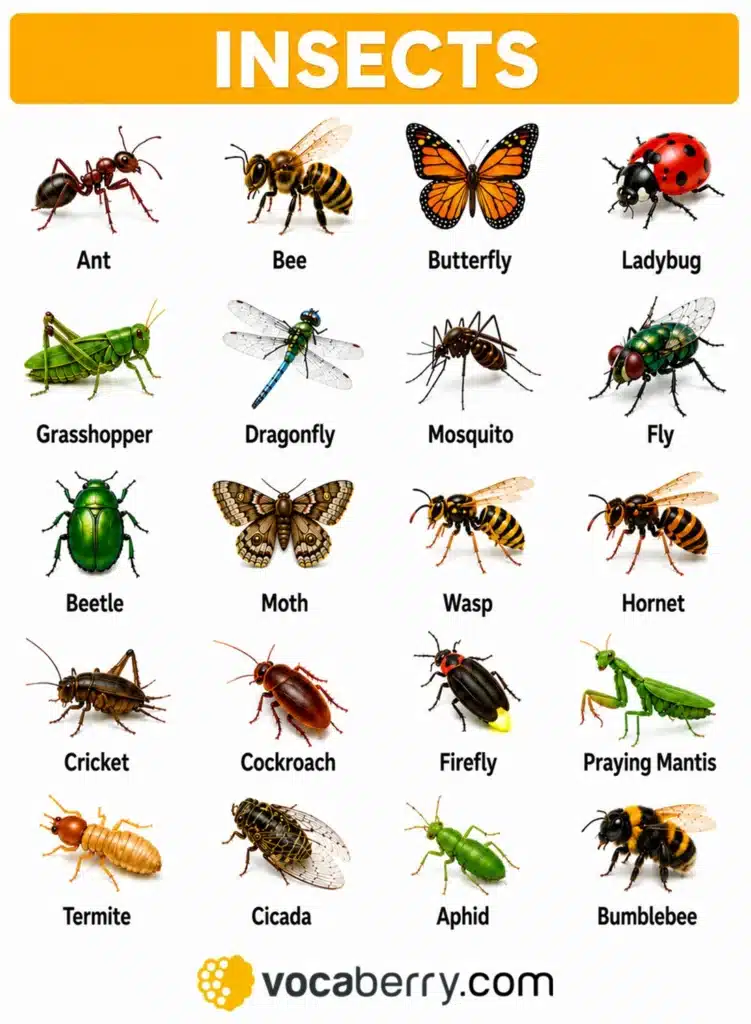
Here is a list of insects you’re likely to encounter in daily life or in nature:
- Ant – a small insect that lives in colonies.
- Bee – a flying insect that collects nectar and pollen.
- Wasp – a flying insect that can sting.
- Hornet – a large type of wasp with a painful sting.
- Butterfly – a colorful flying insect with large wings.
- Moth – a flying insect related to butterflies and often active at night.
- Fly – a common flying insect with one pair of wings.
- Housefly – a common fly often found around homes and food.
- Fruit Fly – a tiny fly often found near ripe fruit.
- Mosquito – a small flying insect that can bite people and animals.
- Gnat – a very small flying insect.
- Beetle – an insect with hard front wings.
- Ladybug – a small round beetle, often red with black spots.
- Firefly – a beetle that can produce light at night.
- Weevil – a small beetle with a long snout.
- Grasshopper – a jumping insect with strong back legs.
- Cricket – a jumping insect known for its chirping sound.
- Locust – a grasshopper that can form large swarms.
- Cockroach – a fast-moving insect often found in warm places.
- Termite – a social insect that feeds on wood.
- Dragonfly – a fast-flying insect often found near water.
- Damselfly – a slender insect closely related to dragonflies.
- Praying Mantis – a predatory insect with strong front legs.
- Cicada – an insect known for its loud summer sound.
- Aphid – a tiny insect that feeds on plant sap.
- Stink Bug – an insect that releases a strong smell when disturbed.
- Bedbug – a small insect that feeds on blood.
- Flea – a tiny jumping insect that feeds on blood.
- Louse – a small parasitic insect that lives on a host.
- Earwig – an insect with pincers at the end of its body.
- Silverfish – a small silver-colored wingless insect.
- Stick Insect – a long insect that looks like a stick.
- Leaf Insect – an insect whose body looks like a leaf.
- Lacewing – a delicate insect with clear, veined wings.
- Hoverfly – a fly that can hover and often looks like a bee.
- Horsefly – a large fly that can give painful bites.
- Yellowjacket – a black-and-yellow wasp that can sting.
- Bumblebee – a large fuzzy bee commonly seen around flowers.
- Honey Bee – a social bee that produces honey.
- Carpenter Bee – a large bee that nests in wood.
- Water Strider – an insect that moves across the surface of water.
- Leafhopper – a small jumping insect that feeds on plants.
- Planthopper – a small plant-feeding insect that jumps.
- Scale Insect – a tiny plant-feeding insect often found on stems.
- Thrips – a very small insect that often feeds on plants.
- Crane Fly – a long-legged fly that looks like a large mosquito.
- Mole Cricket – a cricket with front legs adapted for digging.
- Katydid – a green jumping insect related to crickets.
- Antlion – an insect whose larvae often trap small insects in sand.
- Dobsonfly – a large winged insect often found near water.
Insect or Bug?
In everyday English, bug is often used as a general word for small insects and similar creatures. People may even use it for spiders, although spiders are not insects.
In science, however, true bug refers specifically to insects in the order Hemiptera, such as stink bugs, bedbugs, and aphids. In everyday conversation, both bug and insect are common, but insect is more accurate in scientific or formal English.
Useful Words Related to Insects
These common words can help you describe insects, their behavior, and their life cycle more clearly:
- Sting – to pierce the skin with a stinger, often to inject venom.
- Bite – to cut or pierce the skin with the mouthparts.
- Buzz – a low humming sound made by insects such as bees and flies.
- Swarm – a large group of insects moving or flying together.
- Pest – an insect or other animal that causes damage or problems.
- Colony – a group of social insects, such as ants or bees, living together.
- Larva – the young form of an insect before adulthood. The plural is larvae.
- Pupa – the stage between larva and adult in insects with complete metamorphosis.
- Caterpillar – the larval stage of a butterfly or moth.
- Cocoon – a protective covering made by some insect larvae around the pupal stage.
- Hive – a place where a colony of honey bees lives.
- Nest – a place where insects live, lay eggs, or raise their young.
- Antenna – one of the sensory structures on an insect’s head.
- Wings – body parts that allow many adult insects to fly.
- Pollinate – to carry pollen between flowers and help plants reproduce.
- Metamorphosis – the process in which an insect changes form as it develops.
Conclusion
From ants and bees to butterflies and dragonflies, insects come in many different forms. Knowing these insect names and related words gives you useful vocabulary for talking about the small creatures you see in everyday life and nature.