Modal verbs are special verbs that help us express ability, possibility, permission, advice, and obligation. English learners often confuse modal verbs like can, could, may, might, must, and should because each one has a different meaning and use.
Test your English with this modal verbs quiz and improve your grammar by choosing the correct modal verb to complete each sentence.
Choose the correct modal verb to complete each sentence (1–10).
1) We ___ be careful when driving in snow.
“Have to” shows necessity because of a situation. Snow makes driving dangerous, so being careful is required.
2) ___ I carry that bag for you? It looks heavy.
“Shall I” is used to offer help politely. It is common in polite or slightly formal situations.
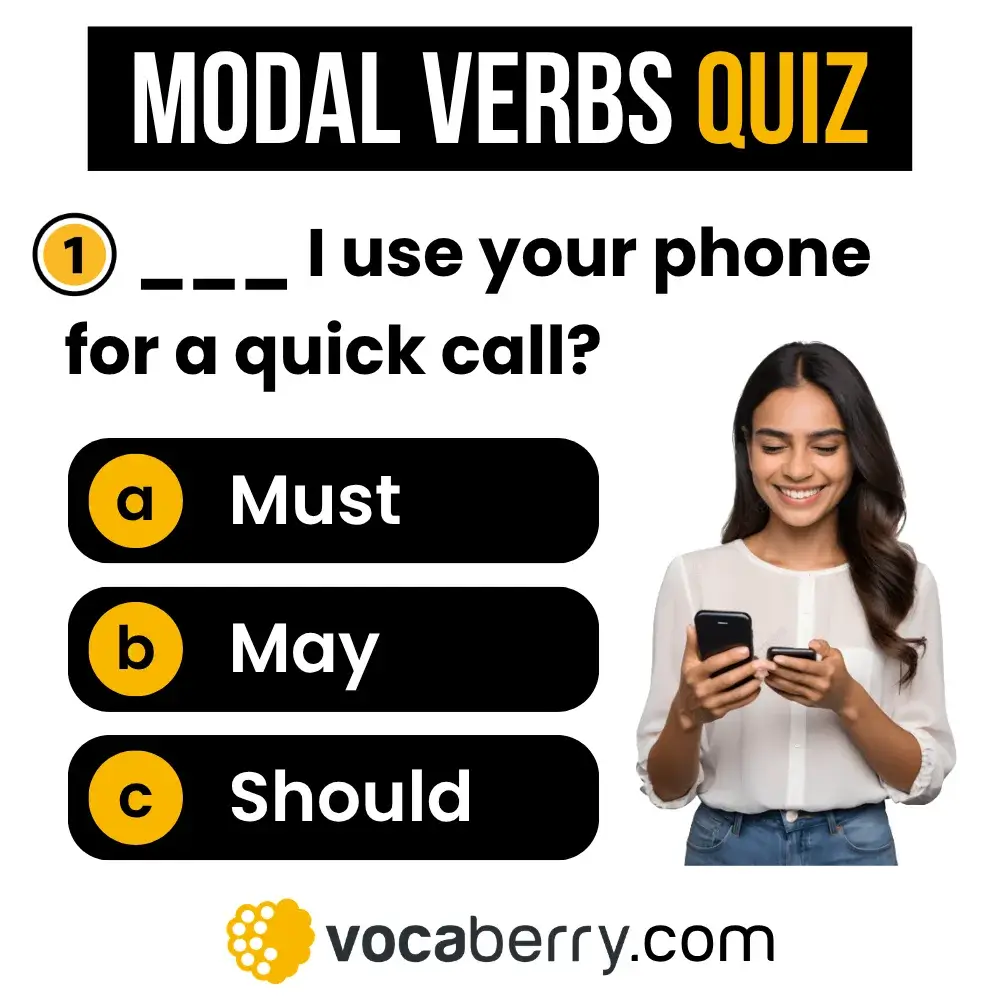
3) ___ I use your phone for a quick call?
May is used to ask for permission in a polite way. It is more formal than can.
4) He ___ help us if he had more free time.
Would is used in unreal or imagined situations. This sentence talks about something that is not real now.
5) You ___ stop when the traffic light turns red.
Must shows a strong rule or obligation. It is often used for laws.
6) He ___ speak three different languages fluently.
Can is used to show ability. It means he is able to speak those languages.
7) You ___ see a doctor. You have a high fever.
Should is used to give advice. It suggests the best thing to do in this situation.
8) He ___ be at home, but I haven’t checked yet.
Might shows possibility. The speaker is not sure if it is true.
9) He ___ take the bus because his car isn't working.
“Has to” shows necessity caused by a situation. He has no choice because his car is not working.
10) ___ you help me with this box for a minute?
“Could you” is used to make a polite request. It sounds softer and more polite than can.
Share your Results:
🎯 What’s next?
Keep learning with more English quizzes: