Many English learners feel confused about stative verbs because they are used differently from action verbs. They describe states, feelings, thoughts, and possession rather than physical actions, which makes them tricky in continuous tenses like the present continuous.
In this article, you will learn what stative verbs are, the main types, when they are not used in continuous forms, and how they differ from action verbs, with clear explanations and practical examples.
What Are Stative Verbs?
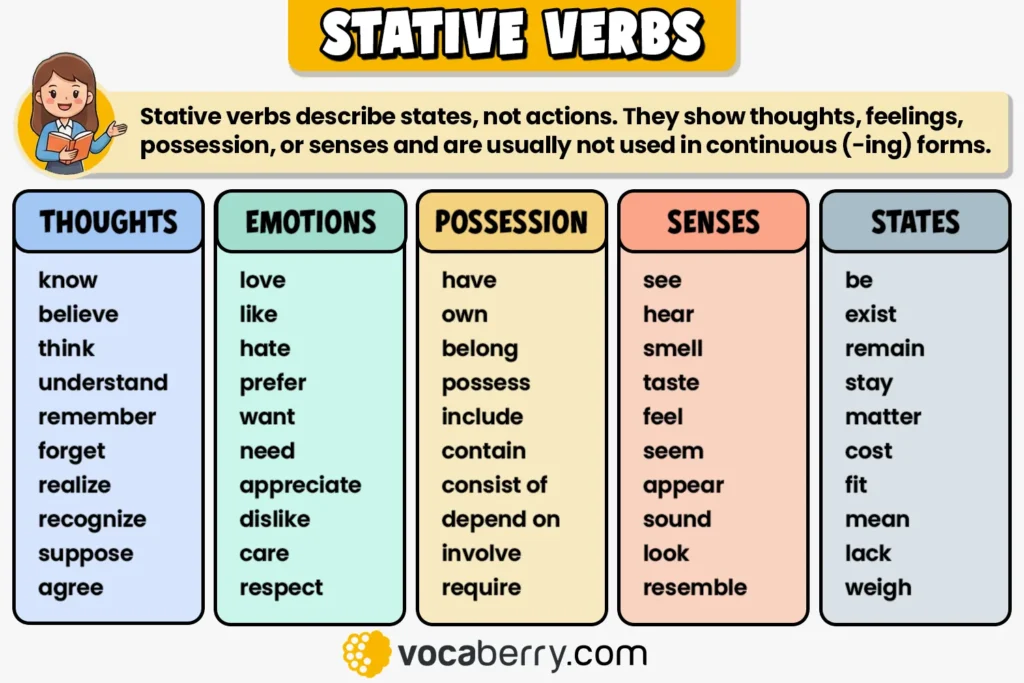
Stative verbs are verbs that describe a state or condition, not a physical action. They show thoughts, emotions, possession, relationships, senses, or situations. Instead of showing what someone is doing, they describe how someone feels, thinks, or what they have.
Stative verbs usually describe something that exists or is true for a period of time. They do not show visible movement or temporary activity.
Examples:
- I know the answer.
- She likes chocolate.
- We believe your story.
- This cake tastes delicious.
- I understand the problem.
Types of Stative Verbs
Stative verbs can be grouped by meaning. This makes it easier to understand how they are used in sentences.
Mental State Verbs
These verbs describe thoughts, knowledge, opinions, and understanding. They show what happens in the mind rather than physical actions.
| Verb | Example |
|---|---|
| know | I know her name. |
| believe | She believes everything he says. |
| understand | We understand the instructions. |
| remember | He remembers his first teacher. |
| think | I think this is a good idea. |
| doubt | They doubt the results. |
Emotion Verbs
These verbs describe feelings and emotional states. They often show personal preferences, desires, or reactions.
| Verb | Example |
|---|---|
| love | She loves classical music. |
| like | I like this movie. |
| prefer | I prefer coffee to tea. |
| need | They need more time. |
| appreciate | We appreciate your help. |
| hate | He hates waking up early. |
| care | I care about my family. |
| fear | She fears the dark. |
Possession and Relationship Verbs
These verbs describe ownership, belonging, or relationships between people or things. They show what someone has or what something includes.
| Verb | Example |
|---|---|
| have | I have two brothers. |
| own | She owns a small business. |
| belong | This book belongs to Sarah. |
| possess | He possesses strong leadership skills. |
| contain | The bottle contains water. |
| consist of | The team consists of five players. |
| depend on | Success depends on effort. |
| include | The price includes tax. |
Senses and Perception Verbs
These verbs describe perception when they express a general state rather than an active action. They often describe how something appears, sounds, smells, or feels.
| Verb | Example |
|---|---|
| see | I see a problem here. |
| hear | She hears music in the distance. |
| smell | The flowers smell wonderful. |
| taste | The soup tastes salty. |
| feel | The fabric feels soft. |
| seem | He seems nervous. |
| appear | She appears tired. |
| sound | That idea sounds interesting. |
Stative Verbs in Continuous Tenses
Stative verbs are not usually used in continuous (-ing) tenses because they describe a state, not a temporary action. Even if something is happening now, we normally use the simple tense with stative verbs.
Correct: I know the answer.
Wrong: I am knowing the answer.
Correct: She likes the movie.
Wrong: She is liking the movie.
Correct: He believes you.
Wrong: He is believing you
Verbs That Can Be Both Stative and Action
Some verbs can be stative in one sentence and action verbs in another. The meaning of the sentence determines how the verb functions.
Think
- I think you are right. (opinion – stative)
- I am thinking about the problem. (process – action)
Have
- I have a new car. (possession – stative)
- I am having dinner. (activity – action)
See
- I see your point. (understand – stative)
- I am seeing a dentist tomorrow. (meeting – action)
Feel
- I feel tired. (state – stative)
- She is feeling the fabric. (touching – action)
Taste
- The soup tastes good. (perception – stative)
- The chef is tasting the soup. (action – action verb)
Stative Verbs vs. Action Verbs
Action verbs describe actions that happen and show movement, activity, or change because the subject is doing something. On the other hand, stative verbs describe states or conditions such as feelings, thoughts, possession, or relationships, and they describe situations rather than actions.
Action Verb Examples:
- She runs every morning.
- They are building a house.
- We played football yesterday.
Stative Verb Examples:
- She loves music.
- They own a house.
- He knows the answer.
Frequently Asked Questions About Stative Verbs
What are stative verbs?
Stative verbs describe states, not actions. They show thoughts, feelings, possession, senses, or conditions instead of physical activity.
Why are stative verbs not used in continuous tenses?
Stative verbs describe situations that exist, not actions in progress. For this reason, they are not usually used in continuous (-ing) forms.
What is the difference between stative and action verbs?
Action verbs show movement or activity, while stative verbs describe states such as thoughts, feelings, or possession. Action verbs are commonly used in continuous tenses, but stative verbs usually are not.
Can stative verbs ever be used in continuous forms?
Some verbs can be both stative and action depending on meaning. For example, “I think you are right” is stative, but “I am thinking about the problem” describes an action.
What are common examples of stative verbs?
Common stative verbs include know, believe, love, like, prefer, own, have, seem, understand, remember, want, need, and belong.