Quantifiers are words we use to talk about quantity. They help us say how much or how many of something we have, and they are very common in everyday English. In this article, you will learn the different types of quantifiers and how to use them with countable and uncountable nouns, along with clear examples.
What Are Quantifiers?
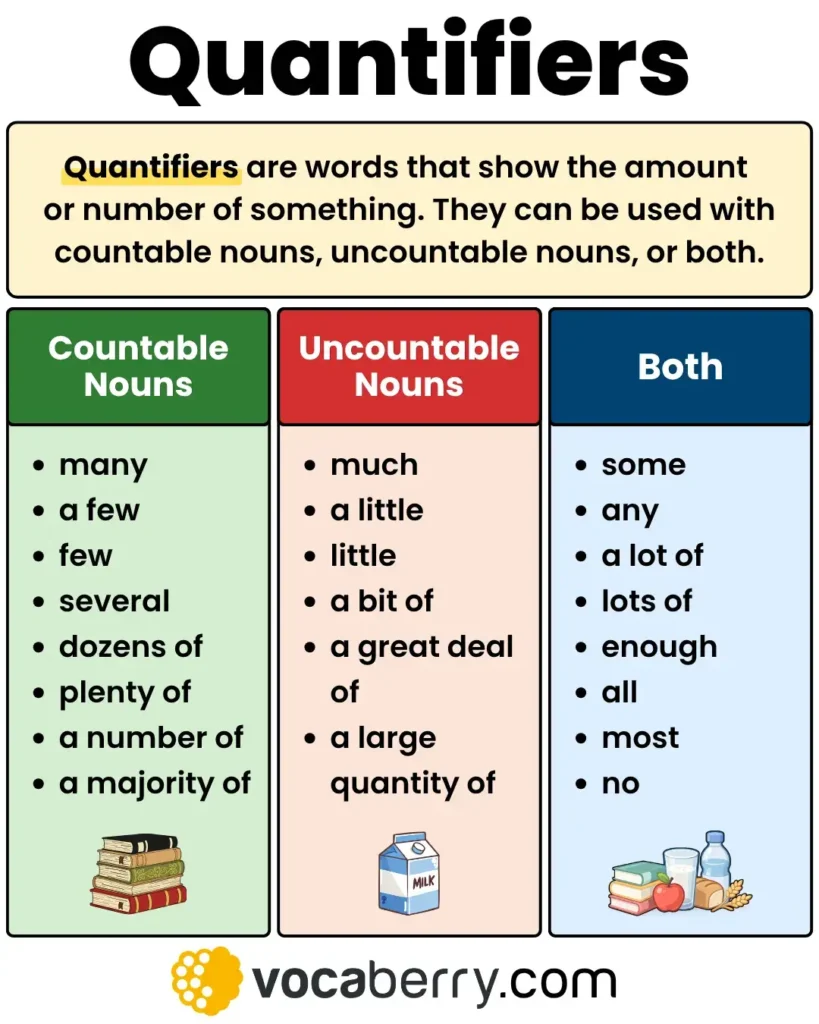
Quantifiers are words that describe quantity. They are used before nouns to show the amount or number of something. They help answer questions like “How much?” and “How many?”.
There are different types of quantifiers. Some are used with countable nouns, some with uncountable nouns, and some can be used with both.
Examples:
- I have some water.
- There are many people here.
- She bought a few apples.
Quantifiers with Countable Nouns
Countable nouns are things we can count, such as books, cars, and people. They have singular and plural forms. Some quantifiers are only used with countable nouns, and not with uncountable nouns.
Many
We use many to talk about a large number of things. It is more common in questions and negative sentences than in positive sentences.
Examples:
- Are there many students in the class?
- There are not many shops here.
- How many books do you have?
A Few vs Few
Both a few and few are used with plural countable nouns. A few means a small number and has a positive meaning. Few means almost none and has a negative meaning.
Examples:
- I have a few friends in this city.
- I have few friends here.
- She bought a few books.
- She bought few books.
Several
We use several to show a number that is more than a few but not very large.
Examples:
- I visited several countries last year.
- She asked several questions.
- We met several people at the event.
A Number of
A number of means some or a group of people or things. It is followed by a plural noun.
Examples:
- A number of students are absent today.
- We saw a number of interesting places.
- A number of problems appeared.
Quantifiers with Uncountable Nouns
Uncountable nouns are things we cannot count, such as water, money, and information. They do not have a plural form. Some quantifiers are only used with uncountable nouns, and not with countable nouns.
Much
We use much to talk about a large amount of something. It is mainly used in questions and negative sentences.
Examples:
- Do you have much time?
- I don’t have much money.
- How much water do you drink?
A Little vs Little
Both a little and little are used with uncountable nouns. A little means a small amount, but it is enough or positive. Little means almost no amount and has a negative meaning.
Examples:
- I have a little time before the meeting.
- I have little time, so I must hurry.
- There is a little milk in the fridge.
- There is little milk left.
A Bit of
A bit of means a small amount. It is informal and commonly used in everyday English.
Examples:
- I need a bit of help.
- Add a bit of sugar.
- He has a bit of experience.
A Great Deal of
A great deal of means a large amount. It is more formal and often used in written English.
Examples:
- She has a great deal of experience.
- They spent a great deal of money.
- He showed a great deal of interest.
Quantifiers for Countable and Uncountable Nouns
Some quantifiers can be used with both countable and uncountable nouns. These quantifiers are very common and important in English.
Some
We use some mainly in positive sentences and sometimes in offers and requests.
Examples:
- I have some friends in London.
- There is some water on the table.
- Would you like some coffee?
Any
We use any in questions and negative sentences, and sometimes in positive sentences with a general meaning.
Examples:
- Do you have any questions?
- I don’t have any money.
- Is there any milk?
A Lot of / Lots of
We use a lot of and lots of to show a large amount or number. They are very common in everyday English and can be used with both types of nouns.
Examples:
- She has a lot of books.
- We have lots of time.
- There is a lot of work to do.
Enough
Enough means the amount we need or the right amount. It can be used before nouns and after adjectives.
Examples:
- I have enough money.
- We don’t have enough chairs.
- This room is big enough.
All
All means the total number or the whole amount of something.
Examples:
- All students are ready.
- She ate all the food.
- All the water is gone.
Most
Most means more than half of something.
Examples:
- Most people like music.
- Most students passed the exam.
- Most of the water is clean.
No
No means zero or none.
Examples:
- There is no milk in the fridge.
- I have no time today.
- There are no problems.
Quantifiers Quiz
1. I don’t have ___ time to finish my homework.
a) many
b) much
c) several
2. She has ___ friends in her class, so she is happy.
a) few
b) a few
c) little
3. There are ___ books on the table.
a) much
b) many
c) little
4. We have ___ time before the lesson starts, so let’s talk.
a) little
b) a little
c) many
5. Do you have ___ questions about this topic?
a) some
b) any
c) much
6. He doesn’t have ___ money to buy a new phone.
a) many
b) much
c) several
7. There is ___ milk left, so we need to buy more.
a) little
b) a few
c) many
8. We visited ___ places during our holiday.
a) much
b) several
c) little
9. I need ___ help with this exercise.
a) a bit of
b) many
c) several
10. There are ___ chairs for everyone in the room.
a) enough
b) much
c) little
Quiz Answers
1) I don’t have much time to finish my homework.
2) She has a few friends in her class, so she is happy.
3) There are many books on the table.
4) We have a little time before the lesson starts, so let’s talk.
5) Do you have any questions about this topic?
6) He doesn’t have much money to buy a new phone.
7) There is little milk left, so we need to buy more.
8) We visited several places during our holiday.
9) I need a bit of help with this exercise.
10) There are enough chairs for everyone in the room.