Many English learners feel confused about lie and lay because they look similar and their past forms are especially confusing. Since one verb needs an object and the other does not, it is easy to use the wrong one. In this article, you will learn the difference between lie and lay, their verb forms, the grammar rules, and how to use them correctly with clear examples.
What Does Lie Mean?
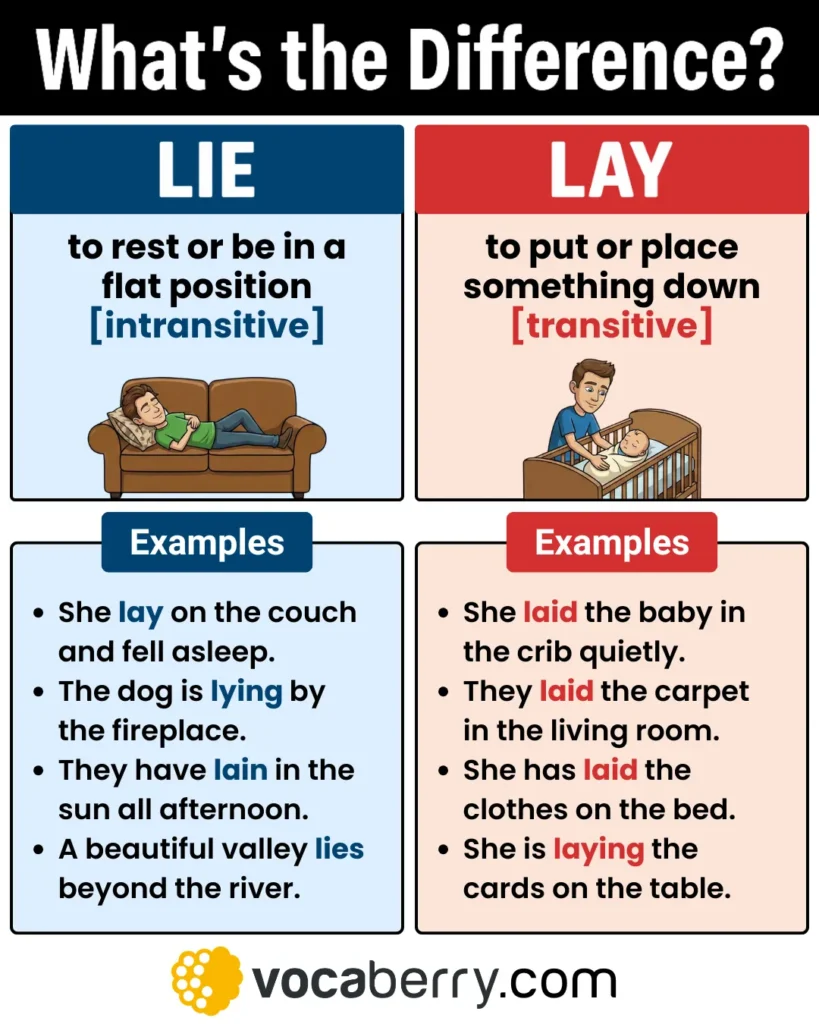
The verb lie most commonly means to rest, recline, or be in a flat position. When someone lies down, they move into or remain in a horizontal position. When something lies somewhere, it is already resting in that place.
In this meaning, lie does not take an object. The subject performs the action alone. This makes it an intransitive verb.
Examples:
- I lie on the sofa after work.
- The cat lies on the bed.
- The phone is lying on the table.
- Yesterday, I lay on the beach.
- She has lain there for hours.
Verb Forms of Lie (to rest)
| Tense | Form | Example Sentence |
|---|---|---|
| Base Form | lie | I like to lie down early. |
| Present Simple | lie / lies | She lies on the couch every evening. |
| Past Simple | lay | Yesterday, he lay in bed all morning. |
| Past Participle | lain | She has lain there since noon. |
| Present Participle (-ing) | lying | The baby is lying on the floor. |
“Lie” Also Means To Say Something That Is Not True
The verb lie has another completely different meaning. It can also mean to say something false or not true. Although it is spelled the same, its verb forms are different from “lie” (rest).
This verb is also intransitive and is usually followed by “to someone.”
Examples:
- He lies to his parents.
- She lied about her age.
- They have lied before.
- Why are you lying to me?
Verb Forms of Lie (to say something untrue)
| Tense | Form | Example Sentence |
|---|---|---|
| Base Form | lie | It is wrong to lie. |
| Present Simple | lie / lies | He lies all the time. |
| Past Simple | lied | She lied about the test. |
| Past Participle | lied | They have lied to us. |
| Present Participle (-ing) | lying | He is lying to the teacher. |
What Does Lay Mean?
The verb lay means to put or place something down carefully or deliberately. Unlike “lie” (rest), this verb always needs an object. Someone lays something somewhere.
Because it needs an object, “lay” is a transitive verb.
Examples:
- She lays the book on the table.
- Please lay the baby on the bed.
- He laid the keys on the counter.
- They are laying the carpet in the living room.
- She has laid the plates on the table.
Verb Forms of Lay (to put something down)
| Tense | Form | Example Sentence |
|---|---|---|
| Base Form | lay | Please lay the phone on the desk. |
| Present Simple | lay / lays | She lays the clothes on the chair. |
| Past Simple | laid | He laid the bag on the floor. |
| Past Participle | laid | They have laid the table for dinner. |
| Present Participle (-ing) | laying | She is laying the carpet. |
Difference Between Lie and Lay
The main difference between lie and lay is that lie does not take an object, while lay always needs a direct object. Lie means to rest or be in a flat position, and lay means to put something down. In simple terms, you lie down yourself, but you lay something down.
The table below shows the complete verb forms of lie and lay.
| Verb | Base | Past Simple | Past Participle | Present Participle |
|---|---|---|---|---|
| Lie (rest) | lie | lay | lain | lying |
| Lay (put) | lay | laid | laid | laying |
| Lie (tell a lie) | lie | lied | lied | lying |
Now it’s your turn — can you really tell the difference between lie and lay?
Take the Lie vs. Lay Quiz and see if you can choose the correct verb every time.
👉 Start the Quiz