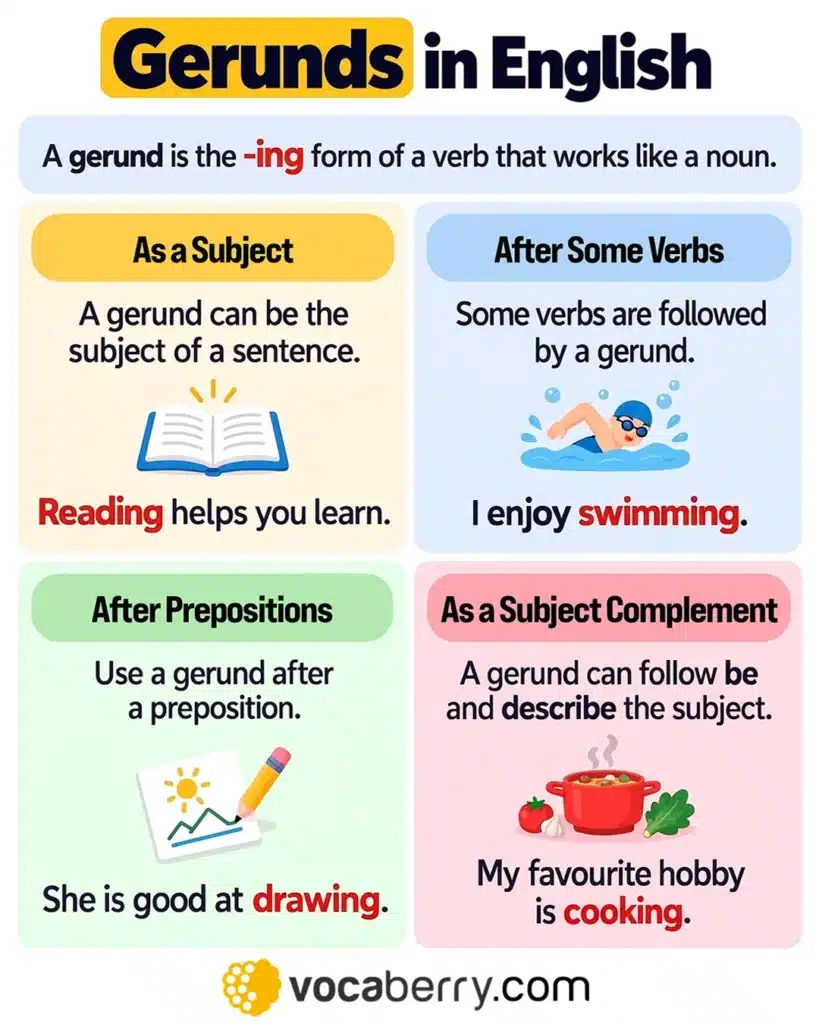
Gerunds are -ing forms of verbs that function as nouns. They are common in English and can be used in different parts of a sentence. In this lesson, you’ll learn what gerunds are, how to form them, how to use them, and how they differ from present participles.
What Is a Gerund?
A gerund is the -ing form of a verb used as a noun. Although it comes from a verb, it works like a noun in a sentence and can name an activity or action. For example, the verb swim becomes the gerund swimming when it refers to the activity itself.
- Swimming is good exercise.
- I enjoy reading before bed.
- She is interested in learning Spanish.
How to Form Gerunds
Gerunds are formed by adding -ing to the base form of a verb. The basic structure is verb + -ing, but some verbs require a spelling change when -ing is added.
- For most verbs, simply add -ing: read → reading
- If a verb ends in -e, remove the final -e: write → writing
- For some short verbs, double the final consonant: run → running
- If a verb ends in -ie, change -ie to -y: lie → lying
Uses of Gerunds
Gerunds can have several functions in a sentence. They can be used as subjects, objects of verbs, after prepositions, and as subject complements.
Gerunds as Subjects
A gerund can be used as the subject of a sentence. In this position, it usually names an activity or action. A gerund used as a subject is normally treated as singular.
- Reading helps you learn new words.
- Walking is good for your health.
- Learning English takes time and practice.
Gerunds as Objects of Verbs
Some verbs are followed by a gerund. In this structure, the gerund is the object of the verb. Common verbs that take a gerund include enjoy, avoid, finish, keep, mind, suggest, consider, practice, and recommend.
- I enjoy listening to music.
- She finished cleaning the kitchen.
- He avoids driving at night.
Gerunds After Prepositions
When a verb comes after a preposition, we normally use the gerund form. Common prepositions include in, at, for, about, without, before, after, and by.
- She is good at drawing.
- Thank you for helping me.
- He left without saying goodbye.
Gerunds as Subject Complements
A gerund can be used as a subject complement, usually after a form of the verb be. It gives more information about the subject and often describes an activity connected with it.
- My favorite hobby is painting.
- Her favorite activity is reading.
- The hardest part is getting started.
Gerunds vs. Present Participles
Gerunds and present participles have the same verb + -ing form, but they have different functions. A gerund functions as a noun, while a present participle is used as part of a continuous verb form or to describe a noun.
Gerunds:
- Running is good exercise.
- I enjoy running in the morning.
- She is interested in running a marathon.
Present participles:
- She is running in the park.
- They were waiting for the bus.
- We watched the falling snow.