
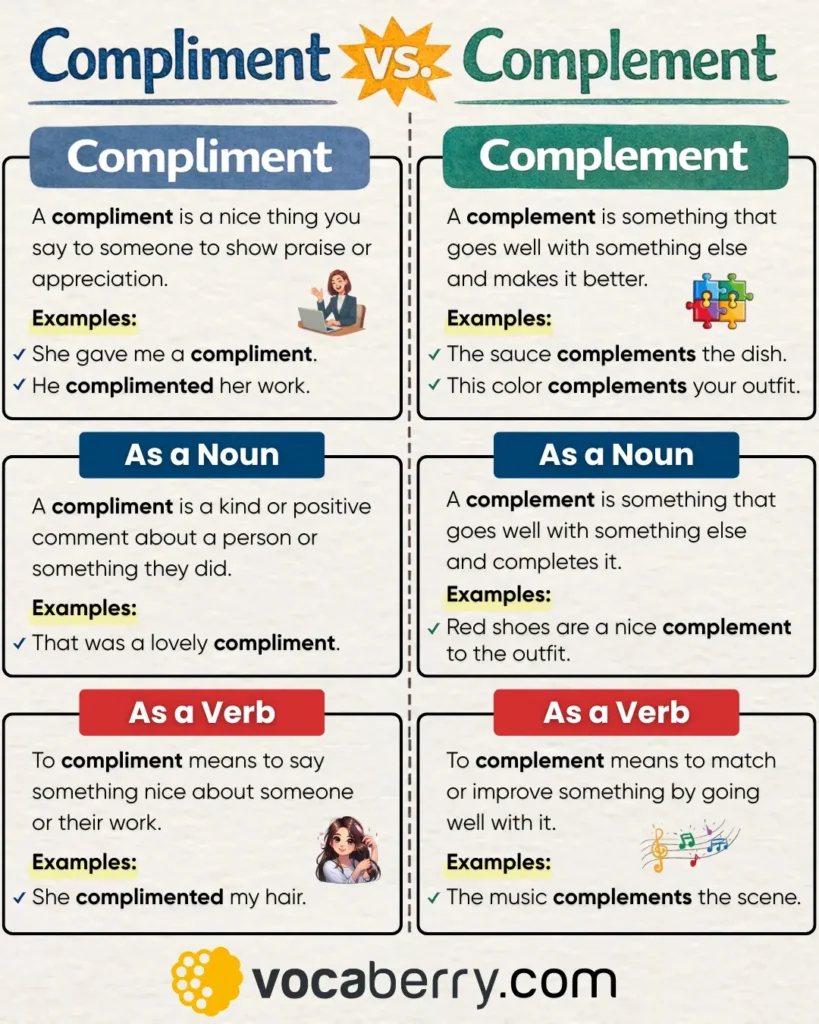
In English, compliment and complement look and sound very similar, but they have completely different meanings. Because they are pronounced the same, many learners confuse them in writing.
In this article, you will learn what compliment and complement mean, how they are used as nouns and verbs, and how to understand the difference with explanations and examples.
What Does “Compliment” Mean?
Compliment can be used as both a noun and a verb. It is used when we say something nice about a person or a thing. Compliments express praise, admiration, or positive feelings, and they are very common in everyday English.
This word is always connected to kind words, positive comments, or praise, not to completing something. (That meaning belongs to complement.)
As a Noun
As a noun, a compliment is a kind or positive comment that you give to someone. It can be about appearance, skills, personality, behavior, or work.
We often use these patterns:
- give someone a compliment
- pay someone a compliment
- receive a compliment
Examples:
- She received many compliments on her presentation.
- She gave me a compliment about my jacket.
- His teacher paid him a compliment.
- That was a very kind compliment.
As a Verb
As a verb, to compliment means to say something nice to someone. It describes the action of giving praise.
Structure:
- compliment + person
- compliment + person + on + something
Examples:
- She complimented my hair.
- He complimented her on her presentation.
- I want to compliment you on your hard work.
- They complimented him on his cooking.
What Does “Complement” Mean?
Complement can also be used as both a noun and a verb, but its meaning is completely different from compliment. It means to complete, improve, or go well with something.
We use complement when two things work well together and make each other better.
As a Noun
As a noun, a complement is something that completes, improves, or matches something else. It is often used when talking about things that balance, match, or fit well together.
We often use this pattern:
- complement + to + noun
Examples:
- The wine is a perfect complement to the meal.
- This scarf is a nice complement to your outfit.
- Her skills are a great complement to the team.
- The sauce is a good complement to the dish.
As a Verb
As a verb, to complement means to complete or improve something by matching it well.
Structure:
- complement + object
Examples:
- The music complements the movie perfectly.
- This color complements your eyes.
- His experience complements her creativity.
- The design complements the style of the house.
Difference Between Compliment and Complement
Although compliment and complement look very similar, they have completely different meanings.
A compliment is about saying something nice or giving praise.
A complement is about completing, improving, or matching something.
They may look alike, but one is about kind words, and the other is about things working well together. A simple way to remember the difference:
- Compliment = praise
- Complement = complete
Summary Table: Compliment vs. Complement
| Word | Meaning | Example |
|---|---|---|
| Compliment (n) | Kind comment | She gave me a compliment. |
| Compliment (v) | Say something nice | He complimented her work. |
| Complement (n) | Something that completes | The sauce is a complement to the dish. |
| Complement (v) | Complete or match well | The design complements the room. |
Compliment vs. Complement – FAQs
What is the main difference between “compliment” and “complement”?
A compliment is something nice you say to praise someone. A complement is something that completes or improves something else. Although the words look similar, their meanings are different.
Can both words be nouns and verbs?
Yes. Both can be used as nouns and verbs, but their meanings are different. Compliment relates to praise, while complement relates to completing or matching something well.
Are compliment and complement interchangeable?
No, they are not interchangeable. Even though they look and sound similar, they have different meanings and cannot replace each other in a sentence.
Do compliment and complement sound the same?
Yes. They are pronounced the same in English. They are homophones, which means they sound the same but have different meanings and spellings.


