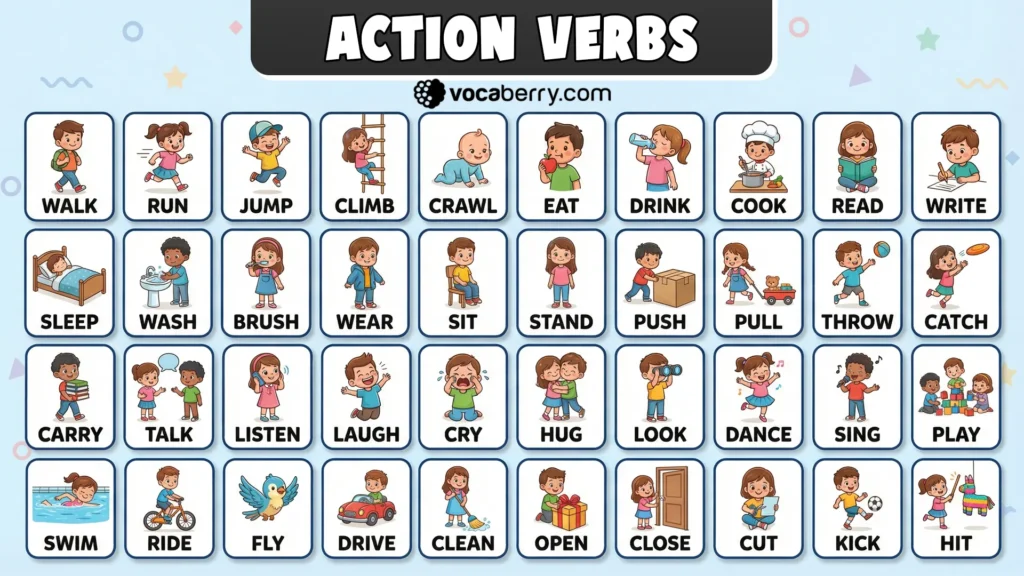
Action verbs are one of the most important parts of English grammar because they show what someone or something does and describe movement, activity, or mental actions. In this article, you will learn what action verbs are, the different types of action verbs, how to use them correctly in sentences and tenses, common action verbs with example sentences, and a list of 100+ action verbs in English.
What Are Action Verbs?
An action verb is a verb that shows what the subject does. It tells us about an action, activity, or process. The action can be physical, such as running, jumping, writing, or opening something. It can also be mental, such as thinking, deciding, remembering, or planning. If the subject is doing something, either with the body or in the mind, the verb is usually an action verb.
Action verbs answer the question: “What is the subject doing?” They can describe movement (run, walk), daily activities (eat, study), communication (speak, explain), mental processes (think, choose), or change (grow, improve). Action verbs are used in all tenses and change form depending on time and subject.
Examples:
- She runs every morning.
- They built a bridge last year.
- I am reading a new book.
- He decided to leave early.
- We will start the meeting at 9 a.m.
Types of Action Verbs
Action verbs can describe different kinds of actions. The two main types are physical action verbs and mental action verbs. Both show that the subject is doing something, but one type can be seen and the other happens in the mind.
Physical Action Verbs
Physical action verbs describe actions that you can see with your eyes. They show movement or physical activity. When a person or thing moves, touches, builds, carries, or changes something physically, the verb is a physical action verb.
Examples:
- The dog chased the ball.
- She opened the window.
- They are building a new house.
Mental Action Verbs
Mental action verbs describe actions that happen in the mind. You cannot see these actions, but they are still actions because the subject is thinking, deciding, remembering, or planning something.
Examples:
- I remember your name.
- She considered the idea carefully.
- We decided to leave early.
How to Use Action Verbs
Action verbs change form depending on tense and subject. They can be used in the present, past, future, and continuous tenses. In the present simple, action verbs describe habits, routines, and general facts. In the past simple, they describe completed actions. In the future, they describe actions that will happen. In continuous tenses, they describe actions happening at a specific time. Action verbs also change form with different subjects (for example, adding -s with he, she, or it). Some action verbs are regular and add -ed in the past, while others are irregular and change form completely.
Examples:
- She works in a hospital. (Present simple)
- She worked late yesterday. (Past simple)
- She will work tomorrow. (Future simple)
- She is working right now. (Present continuous)
- They were playing football at 6 p.m. (Past continuous)
- He walks to school. / They walk to school. (Subject change)
- We watched a movie last night. (Regular verb)
- She ate breakfast early. (Irregular verb)
Common Action Verbs in English with Examples
Below is a table of common action verbs with clear example sentences.
| Word | Example Sentences |
|---|---|
| Ask | She asked a question in class. |
| Bring | He brought his laptop to work. |
| Call | I called my friend last night. |
| Catch | She caught the bus on time. |
| Choose | They chose the blue car. |
| Cook | My mother cooks dinner every evening. |
| Cut | He cut the paper with scissors. |
| Drink | We drank coffee after lunch. |
| Drive | She drives to the office every day. |
| Finish | They finished their homework early. |
| Help | He helped his neighbor yesterday. |
| Listen | I listened to music on the bus. |
| Make | She made a cake for her birthday. |
| Meet | We met at the train station. |
| Open | He opened the window. |
| Read | She reads before bed. |
| Send | I sent an email this morning. |
| Speak | They speak English at work. |
| Start | The class started at 8 a.m. |
| Write | He wrote a long message. |
100+ Action Verbs in English (A–Z)
Here is a list of more than 100 action verbs in alphabetical order:
| act | add | adjust | admire |
| admit | adopt | advance | answer |
| arrive | ask | attack | bake |
| balance | bend | bite | blow |
| borrow | bounce | break | bring |
| brush | build | burn | buy |
| call | carry | catch | chase |
| climb | close | collect | cook |
| copy | count | cover | create |
| cut | dance | deliver | dig |
| draw | drink | drive | drop |
| earn | eat | enter | escape |
| exercise | explore | face | fight |
| fill | find | fix | follow |
| gather | grab | greet | grow |
| handle | help | hit | hug |
| hurry | jump | kick | knock |
| laugh | lift | listen | load |
| lock | march | mix | move |
| open | pack | paint | pass |
| pick | plant | play | pull |
| push | read | ride | ring |
| roll | run | save | search |
| send | shake | shoot | shout |
| sing | sit | skate | sleep |
| slide | speak | spin | stand |
| start | step | stop | study |
| swim | take | talk | teach |
| throw | touch | travel | try |
| turn | use | visit | wait |
| walk | wash | watch | win |
| work | write | yell | zoom |
Action Verbs vs. Stative Verbs
Action verbs show what someone does. Stative verbs describe a state, feeling, opinion, or possession. Stative verbs usually do not show activity and are not commonly used in continuous tenses.
Examples:
- She runs every morning. (Action verb)
- She loves chocolate. (Stative verb)
Some verbs can be both action and stative depending on meaning. When the verb shows an opinion or state, it is stative. When it shows an active process happening now, it is an action verb.
Examples:
- I think this is a good idea. (Stative – opinion)
- I am thinking about your question. (Action – active process)
Action Verbs vs. Linking Verbs
Action verbs show what the subject does. Linking verbs do not show action. They connect the subject to more information about the subject, such as a description or identity. The most common linking verb is “to be” (am, is, are, was, were). Other common linking verbs include become, seem, appear, and feel.
Examples:
- She runs every morning. (Action verb)
- She is tired. (Linking verb)
- He became a teacher. (Linking verb)
Some verbs can be linking in one sentence and action in another, depending on meaning. If the verb shows activity, it is an action verb. If it connects the subject to a description, it is a linking verb.
Examples:
- The soup tastes good. (Linking verb)
- She tasted the soup. (Action verb)
Frequently Asked Questions
What is an action verb in English grammar?
An action verb is a verb that shows what the subject does. It describes physical actions (run, eat, write) or mental actions (think, decide, plan). An action verb shows what the subject is doing in a sentence.
How can I tell if a word is an action verb?
To tell if a word is an action verb, ask yourself if the subject is doing something. If the verb shows movement, activity, or a mental action, it is usually an action verb. If it describes a state, feeling, or condition, it is usually not an action verb.
How do I use action verbs correctly in sentences?
Use action verbs to show what the subject does. Make sure the verb matches the subject and tense. In present simple, add -s for he, she, or it. In past simple, use the correct past form. Action verbs can be used in present, past, future, and continuous tenses.
What are some common action verbs in English?
Some common action verbs in English are go, come, eat, drink, read, write, speak, walk, run, play, work, study, open, close, start, finish, watch, listen, build, clean, cook, drive, buy, sell, help, and call.