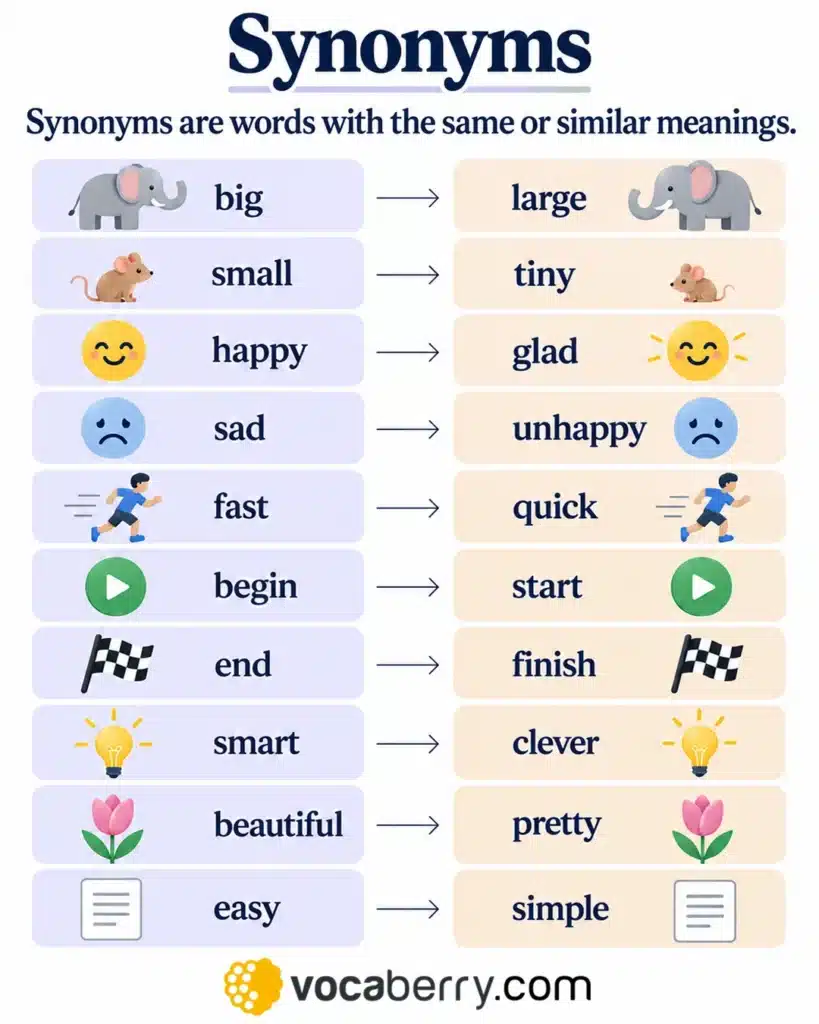
Synonyms are words that have the same or similar meanings. They are common in English and help you express similar ideas with different words. In this lesson, you’ll learn what synonyms are, see common examples, and understand their main types and uses.
What Are Synonyms?
A synonym is a word that has the same or a similar meaning as another word. For example, big and large are synonyms because they both describe something that is greater than average in size. Synonyms help you express the same or similar ideas in different ways and choose words that better fit the meaning or situation.
Examples of Synonyms
Many English words have several synonyms. These words share the same or a similar meaning, but some may differ in strength, tone, or the situations in which they are used.
| Word | Synonyms |
|---|---|
| Angry | Mad, annoyed, furious, irritated |
| Beautiful | Pretty, lovely, attractive, gorgeous |
| Difficult | Hard, challenging, tough, complicated |
| Famous | Well-known, notable, renowned, celebrated |
| Funny | Amusing, humorous, comical, entertaining |
| Important | Significant, essential, major, crucial |
| Quiet | Silent, peaceful, calm, still |
| Rich | Wealthy, affluent, prosperous, well-off |
| Strange | Unusual, odd, weird, peculiar |
| Tired | Exhausted, weary, fatigued, sleepy |
Types of Synonyms
Synonyms can be grouped into two useful types: exact synonyms and near synonyms. Exact synonyms have the same meaning in a particular context, while near synonyms have similar meanings with some differences.
Exact Synonyms
Exact synonyms have the same meaning in a particular context and can often replace each other without changing the sentence. Completely exact synonyms are rare because similar words may still differ in region, style, or use.
| Word | Synonym | Examples |
|---|---|---|
| sofa | couch | We sat on the sofa. We sat on the couch. |
| taxi | cab | We took a taxi to the airport. We took a cab to the airport. |
| begin | start | The meeting will begin at 10 a.m. The meeting will start at 10 a.m. |
Near Synonyms
Near synonyms have similar meanings, but they are not exactly the same. They may differ in strength, formality, emotion, or use. For example, furious is stronger than angry, and tiny means much smaller than small.
| Word | Synonym | Examples |
|---|---|---|
| angry | furious | She was angry about the delay. She was furious about the delay. |
| small | tiny | They live in a small apartment. A tiny insect was on the window. |
| good | excellent | The food was good. The food was excellent. |
| look | stare | She looked at the clock. He stared at the screen. |
Synonyms and Parts of Speech
Synonyms usually belong to the same part of speech because they have similar functions in a sentence. Nouns, verbs, adjectives, and adverbs can all have synonyms.
Noun Synonyms
Noun synonyms are nouns with the same or similar meanings.
- answer → response
- job → occupation
- mistake → error
- idea → thought
- gift → present
Verb Synonyms
Verb synonyms are verbs with the same or similar meanings.
- choose → select
- help → assist
- leave → depart
- repair → fix
- speak → talk
Adjective Synonyms
Adjective synonyms are adjectives with the same or similar meanings.
- brave → courageous
- cold → chilly
- strange → unusual
- weak → feeble
- smart → clever
Adverb Synonyms
Adverb synonyms are adverbs with the same or similar meanings.
- quickly → rapidly
- quietly → silently
- often → frequently
- usually → generally
- finally → eventually
Formal and Informal Synonyms
Some synonyms have similar meanings but differ in formality. Informal words are more common in everyday conversation, while formal words are more common in professional, academic, or official situations.
| Informal | Formal |
|---|---|
| ask | request |
| buy | purchase |
| get | obtain |
| help | assist |
| need | require |
| show | demonstrate |
| start | commence |
| tell | inform |
| use | utilize |
| find out | discover |
| give | provide |
| check | verify |