Infinitives are used in many common English sentence patterns, from talking about plans and purpose to using verbs after modal verbs. In this lesson, you’ll learn the two main types of infinitives and how to use them in different sentence structures.
What Is an Infinitive?
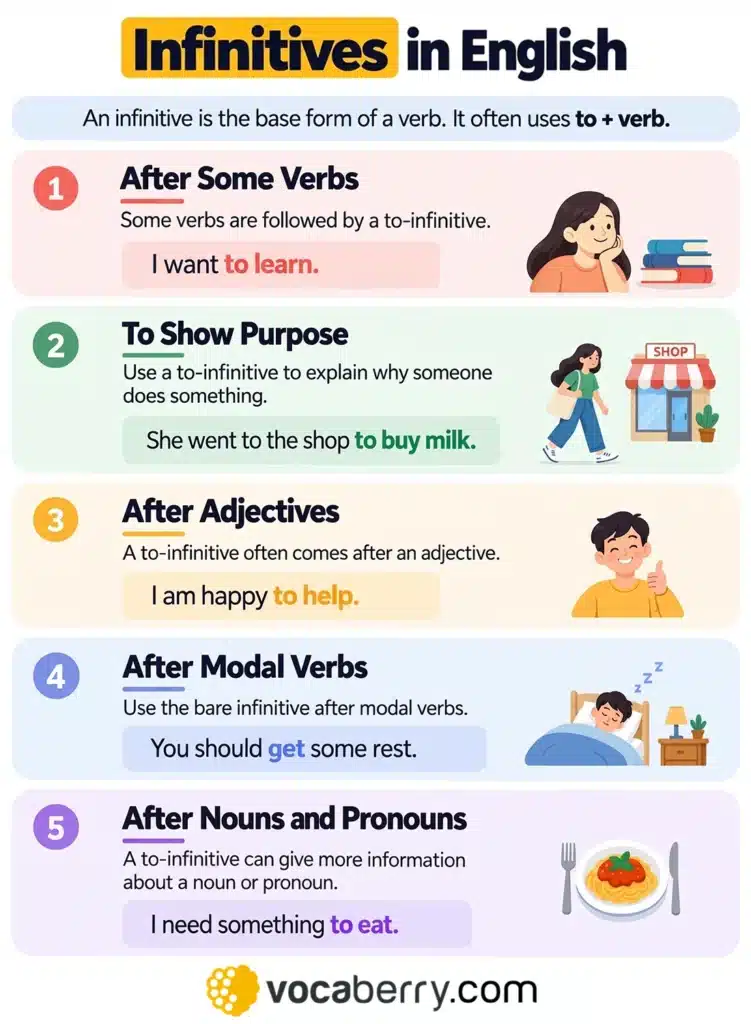
An infinitive is a form of a verb that does not show tense or change according to the subject. It is often used with to, as in to go, to read, and to study, but in some structures it is used without to.
- She wants to learn Spanish.
- We decided to stay home tonight.
- He hopes to find a better job.
Types of Infinitives
There are two main types of infinitives in English: to-infinitives and bare infinitives. A to-infinitive uses to + base verb, while a bare infinitive uses the base verb without to.
To-Infinitives
A to-infinitive is formed with to + base form of the verb. It is the most common infinitive form in English.
- to learn
- to travel
- to work
- to improve
- to understand
Bare Infinitives
A bare infinitive is the base form of a verb without to. It is commonly used after modal verbs and in some other sentence structures.
- You can use my phone.
- We should leave a little earlier.
- She must finish the work today.
Uses of the To-Infinitive
The to-infinitive is used in several common sentence structures. It can follow certain verbs, adjectives, nouns, pronouns, and question words. It can also be used to express purpose and with too and enough.
After Certain Verbs
Many English verbs are followed by a to-infinitive. Common examples include want, need, decide, hope, plan, agree, promise, learn, choose, and refuse.
- She decided to look for a new job.
- We hope to visit Italy next summer.
- He promised to call me after work.
To Express Purpose
A to-infinitive can explain why someone does something. In this use, it expresses the purpose or reason for an action.
- I went to the store to buy some milk.
- She called me to ask a question.
- He joined the course to improve his English.
After Adjectives
A to-infinitive is often used after an adjective to give more information about a feeling, opinion, or situation. Common examples include happy to, ready to, difficult to, and easy to.
- I’m happy to see you again.
- She is ready to start her new job.
- This question is difficult to answer.
After Nouns and Pronouns
A to-infinitive can come after a noun or pronoun to give more information about it. This structure is common with words like something, anything, nothing, and someone.
- I need something to eat before we leave.
- We found a nice place to stay.
- She has a few emails to answer.
After Question Words
A to-infinitive can follow question words such as what, where, when, how, and which. This structure is often used when talking about choices, instructions, or things we do not know.
- I don’t know what to say.
- She showed me how to use the app.
- We haven’t decided where to go yet.
After Too and Enough
A to-infinitive is commonly used with too and enough. Too shows that something is more than needed or possible, while enough shows that something is sufficient.
- It’s too late to call him now.
- This bag is too heavy to carry.
- She is old enough to travel alone.
Uses of the Bare Infinitive
The bare infinitive is the base form of a verb used without to. It is commonly used after modal verbs and after the verbs let and make.
After Modal Verbs
We use the bare infinitive after modal verbs such as can, could, may, might, must, should, will, and would.
modal verb + bare infinitive
- You should get some rest before the trip.
- We might arrive late because of the traffic.
- You must show your ticket before entering.
After Let and Make
The verbs let and make are followed by an object and a bare infinitive. Let means to allow someone to do something, while make means to cause or force someone to do something.
let/make + object + bare infinitive
- My parents let me stay out late.
- The teacher made us finish the work before lunch.
- She let her brother use her laptop.