If and whether can sometimes have the same meaning, but they are not always interchangeable. If is commonly used for conditions, while whether is used when talking about choices or possibilities. In this lesson, you’ll learn the difference between if and whether, when either word is acceptable, and when you need to use one instead of the other.
When to Use If
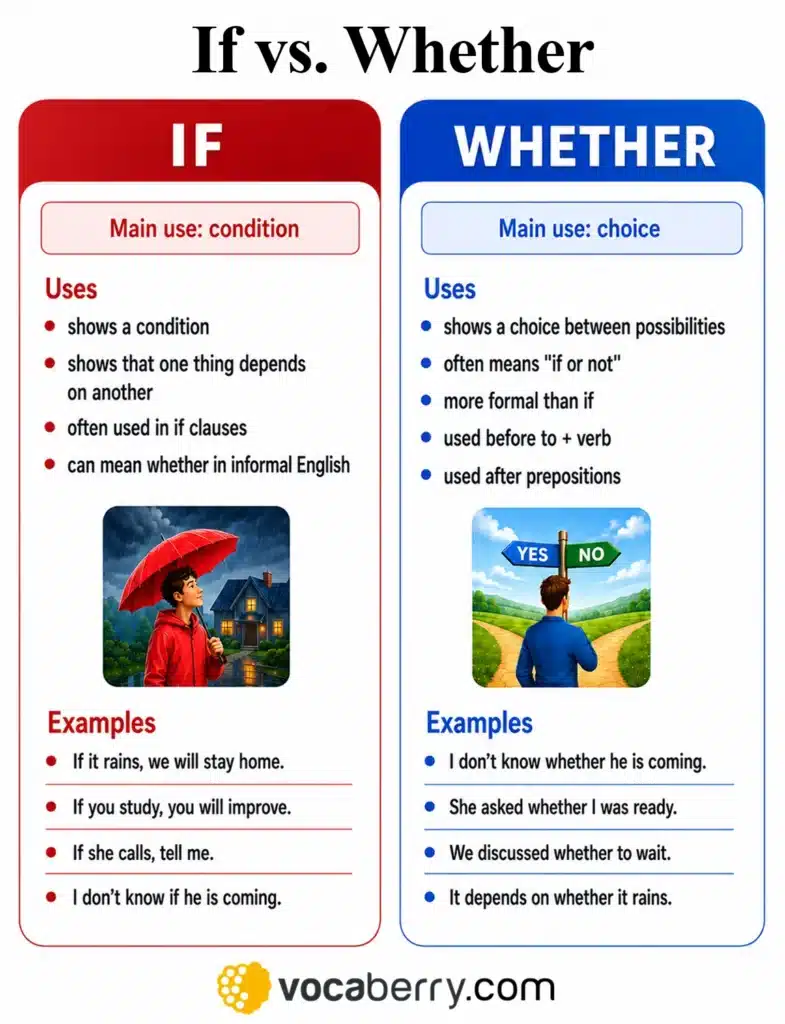
Use if to talk about a condition. In a conditional sentence, one situation depends on another.
Examples:
- I’ll go outside if the weather is nice.
- If it rains, we will stay home.
- Call me if you need help.
- If you study every day, your English will improve.
When to Use Whether
Use whether when talking about two possibilities or choices. Sometimes both choices are stated, and sometimes the second choice is understood. For example, “I don’t know whether he will come” means “I don’t know whether he will come or not.”
Examples:
- She is not sure whether the answer is right or wrong.
- I don’t know whether she will come.
- We need to decide whether to stay or leave.
- He asked whether I wanted tea or coffee.
When If and Whether Are Both Acceptable
In many indirect yes-or-no questions, both if and whether are correct and have the same meaning. In everyday English, if is often more common, while whether can sound slightly more formal.
Examples:
- We don’t know if/whether he received the message.
- I don’t know if/whether she is coming.
- She asked if/whether I was ready.
- I wonder if/whether they are at home.
- Can you check if/whether the door is locked?
When to Use Whether Instead of If
In some sentence structures, whether is the correct choice and if should not be used. The most common cases are before to + verb, after a preposition, and in the expression whether or not.
Before “to + Verb”
Use whether before to + verb when talking about a choice or decision.
Examples:
- I don’t know whether to go.
- She can’t decide whether to buy it.
- We need to choose whether to stay or leave.
After a Preposition
Use whether after a preposition such as about or on.
Examples:
- We talked about whether we should move.
- It depends on whether we have enough time.
- There is some doubt about whether the plan will work.
With “Whether or Not”
Use whether or not when both possibilities are included and the result does not change.
Examples:
- We have to finish the work whether or not we are tired.
- I’m going whether or not you come.
- She will attend whether or not he is there.