In English, may and might are modal verbs we use to talk about possibility, uncertainty, and permission. Learners often find them confusing because they look very similar and are sometimes used interchangeably.
In this article, you will learn what may and might mean, how they are different, and how to use them in the present, future, and past, with examples. You will also see how may is used for permission and wishes, and how might is used for polite suggestions.
What Does May Mean?
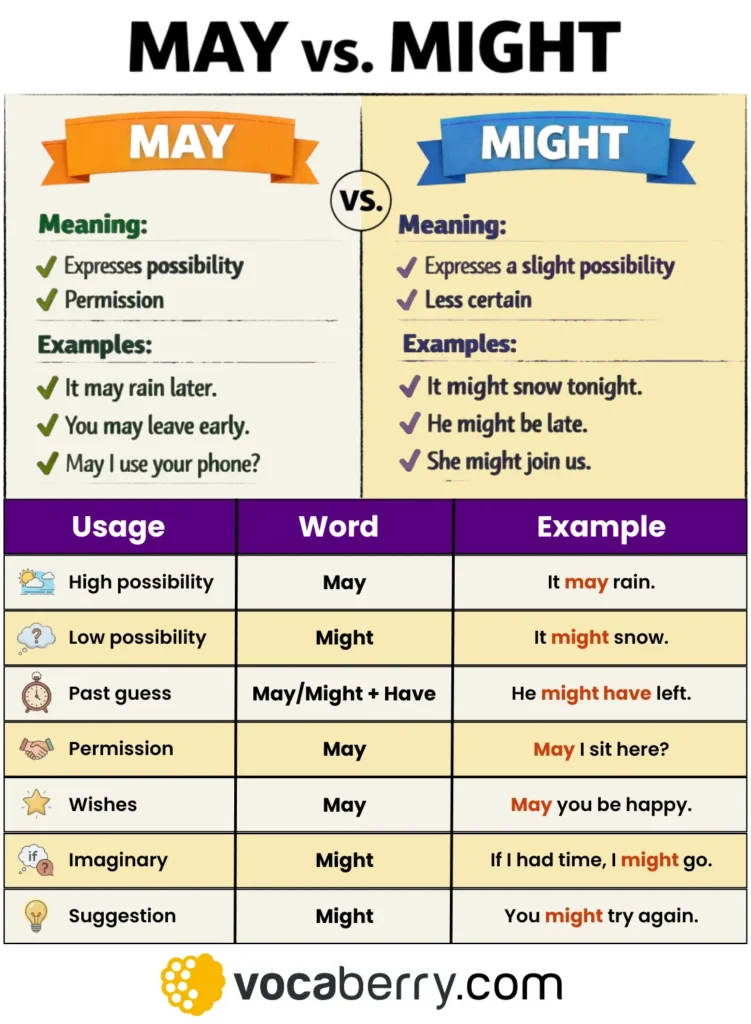
May is a modal verb used to talk about possible situations in the present or the future. When we use may, we think something is possible, but we are not certain. May often sounds slightly more confident or polite than might. It is also commonly used to give permission, especially in formal English.
The verb after may never changes. It stays in the base form. We do not add to, -ing, or -s.
Structure: may + base verb
Examples:
- I may go home early.
- She may be tired.
- It may rain later.
- You may leave the room now.
What Does Might Mean?
Might is also a modal verb used to talk about possibility. It has the same meaning and grammar as may, but it usually sounds less certain. When we use might, we feel more unsure or hesitant about the situation.
Like may, might is used to talk about the present or the future, and the verb after it always stays in the base form.
Structure: might + base verb
Examples:
- I might go home early.
- She might be tired.
- It might rain later.
Difference Between May and Might
There is no grammatical difference between may and might. They follow the same sentence structure and rules. The main difference is how confident the speaker feels.
May sounds a little more confident or neutral.
Might sounds less certain or more cautious.
In everyday English, both are often correct, and people use them interchangeably.
Structure: may / might + base verb
Examples:
- I may be wrong.
- I might be wrong.
Using May and Might for the Present
We use may and might to talk about something that is possible now, but not certain. The situation is happening in the present, or we are guessing about the present.
Structure: may / might + base verb
Examples:
- She may be at home.
- He might be busy right now.
- They may know the answer.
Using May and Might for the Future
We use may and might to talk about future possibilities when we are not sure what will happen.
Structure: may / might + base verb
Examples:
- I may travel next month.
- We might see her later.
- It may snow tomorrow.
Using “May Have” and “Might Have” for the Past
We use may have and might have to talk about possible past situations. The action happened in the past, but we don’t know exactly what happened. We use this form when we guess or make an assumption about the past.
Structure: may / might + have + past participle
Examples:
- She may have forgotten my message.
- He might have missed the bus.
- They may have arrived already.
Using May for Permission
May is often used to ask for or give permission, especially in formal or polite English. We don’t usually use might to ask for permission in modern English.
Structure: may + base verb
Examples:
- May I ask a question?
- You may sit here.
- Students may use dictionaries during the test.
Using Might for Polite Suggestions
We use might to make soft suggestions or gentle advice. This sounds polite and indirect, not strong or forceful.
Structure: might + base verb
Examples:
- You might try again.
- She might want to rest.
- He might consider another option.
Using May to Express Wishes
In very formal or polite English, may is used to express good wishes or hopes for the future. This use is common in greetings, speeches, and written English, but it is not common in everyday conversation. We usually do not use might in this way.
Structure: may + subject + base verb
Examples:
- May you have a safe journey.
- May all your dreams come true.
- May he recover quickly.
May vs. Might – FAQs
What is the difference between “may” and “might”?
There is no difference in grammar. Both are used to talk about possibility. May sounds a little more certain, while might sounds less certain.
Are “may” and “might” interchangeable?
Yes, often, when we talk about possibility. However, “may” is also used for permission and formal wishes, while “might” is used for polite suggestions, so they are not interchangeable in every situation.
Can we use “may” and “might” for the present and the future?
Yes. Both are used to talk about possible situations in the present or the future.
What is the difference between “may have” and “might have”?
Both are used to talk about a possible past situation. They have the same meaning, but might have sounds a little less certain.
Can we use “might” for permission?
Usually no. We normally use “may” for permission. “Might I…?” exists, but it sounds very formal or old-fashioned and is not common in modern English.
Are “may” and “might” formal or informal?
Both can be used in spoken and written English. May sounds more formal, while might is very common in everyday conversation.