If and unless are both used to talk about conditions, but they have different meanings. Use “if” to introduce a condition, and use “unless” to mean “if not.”
Test your English with this if vs. unless quiz and improve your grammar by choosing the correct word to complete each sentence.
Choose the correct word to complete each sentence (1–10).
1) You won’t pass the test ___ you study harder.
"Unless" means "if not," so you won’t pass if you don’t study harder.
2) ___ it rains tomorrow, we will stay home.
"If" is used for a possible future condition.
3) He won’t get better ___ he takes his medicine.
"Unless" means "if not," so he won’t get better if he doesn’t take his medicine.
4) The car won’t start ___ the battery is dead.
"If" introduces a cause-and-result condition.
5) ___ you hurry, we’ll miss the bus.
“Unless” means “if not,” so we’ll miss the bus if you don’t hurry.
6) I’ll take an umbrella ___ the weather looks bad.
"If" expresses a decision depending on a possible situation.
7) ___ she apologizes, he won’t talk to her.
"Unless" means "if not," so he won’t talk to her if she doesn’t apologize.
8) You won’t get a refund ___ you have the receipt.
"Unless" shows the one necessary condition for getting a refund.
9) I’ll join you later ___ I finish my work on time.
"If" introduces the condition needed for the result to happen.
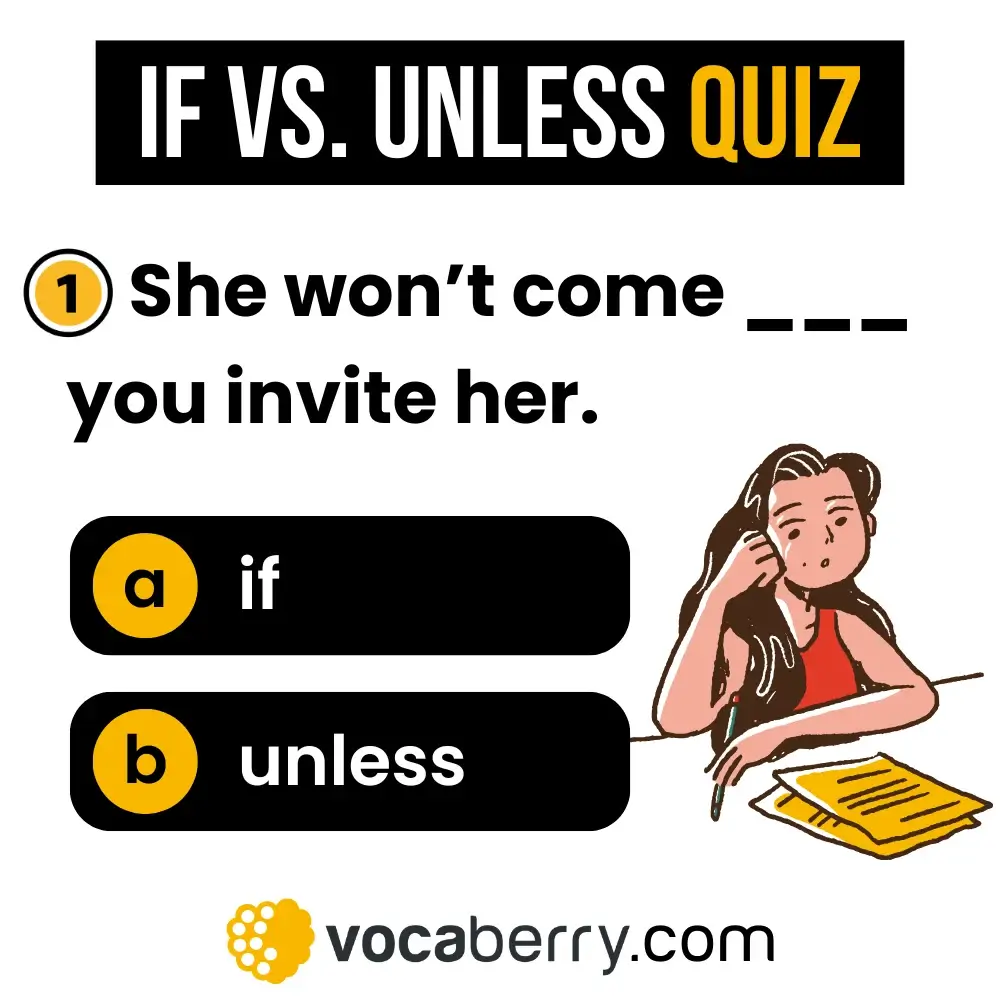
10) She won’t come ___ you invite her.
"Unless" means "if not," so she will only come if you invite her.
Share your Results:
🎯 Finished this quiz? Keep learning!
Improve your grammar with more useful quizzes: