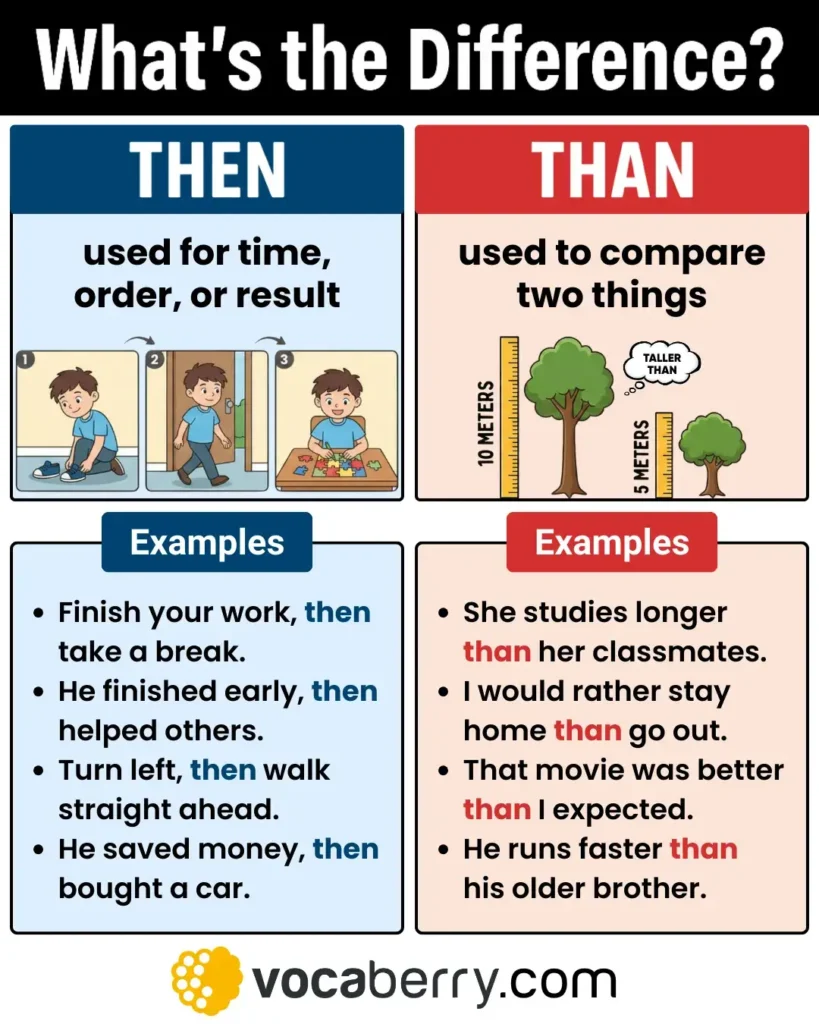
Many English learners confuse then and than because the two words look almost identical. However, they have completely different meanings and grammar uses. Then is related to time, order, and result, while than is used only for comparison.
In this article, you’ll learn the difference between then and than, their meanings, how they are used in English grammar, and how to use them correctly with clear examples.
What Does Then Mean?
Then is mainly used to talk about time, sequence, or result. It usually functions as an adverb. The most important idea to remember is that then is related to time or order, not comparison.
1. Then for Time and Sequence
We use then to show that one action happens after another. It helps organize events in order. This use is very common in instructions, stories, processes, and explanations.
- First, wash your hands. Then start cooking.
- She finished her homework, then she went to bed.
- We went to the bank, then we stopped at the supermarket.
2. Then to Mean “At That Time”
Then can also refer to a specific time in the past or future. In this meaning, it shows what was true at that time. It often appears at the end of a sentence.
- I was living in Paris back then.
- We didn’t know each other then.
- Life was very different then.
3. Then to Show Result
Then can show a result, especially in conditional sentences. It often means “in that case.”
- If you’re tired, then go to bed.
- If it rains, then we’ll stay inside.
- If you don’t understand, then ask the teacher.
4. Then as an Adjective
In more advanced use, then can describe a noun and mean “at that time.” In this case, it comes before the noun.
- The then manager resigned.
- Her then boyfriend lived abroad.
- The then president gave a speech.
What Does Than Mean?
Than is used only for comparison. It connects two things, people, ideas, or actions. When a sentence compares one thing with another, we use than. It usually follows comparative adjectives, comparative adverbs, or words like more, less, and rather.
1. Than After Comparative Adjectives
We use than after adjectives that compare two things. Comparative adjectives often end in -er (taller, smaller, faster) or use more (more interesting, more expensive).
- She is taller than her sister.
- This exam is harder than the last one.
- My car is faster than yours.
2. Than with “More” and “Less”
When we use “more” or “less” to compare nouns or adjectives, we use than after them.
- This movie is more interesting than the book.
- We have less time than yesterday.
- He has more experience than his colleague.
3. Than After Comparative Adverbs
We also use than after adverbs that compare actions.
- She runs faster than me.
- He speaks more clearly than his brother.
- She works harder than everyone else.
4. Than in Preference Structures
Than is used when we show preference between two choices. It often appears with expressions like would rather and rather than.
- I would rather stay home than go out.
- She prefers tea rather than coffee.
- He chose to walk rather than take the bus.
Difference Between Then and Than
The difference between then and than is based on meaning and grammar function. Then is connected to time, order, or result. Than is connected only to comparison. If your sentence talks about what happens next or refers to a time, you need then. If your sentence compares two things, you need than.
Examples:
- We finished dinner, then we watched a movie.
- She is taller than her sister.
- This exam is easier than the last one.
- If you are ready, then we can begin.
Summary Table:
| Word | Main Use | Example Sentence |
|---|---|---|
| Then | Time, order, or result | We ate dinner, then we went home. |
| Than | Comparison | She is taller than me. |
Example Sentences Using Then and Than
These examples show how then and than are used in everyday English. They help you clearly see the difference between time (then) and comparison (than).
Example Sentences with Then
- First, finish your homework carefully. Then you can watch TV.
- She took a quick shower, then she went straight to bed.
- Back then, I didn’t have my own mobile phone.
- If you’re ready now, then let’s begin the lesson.
- We had dinner together and then watched a movie.
- He studied very hard for many years. Then he became a doctor.
- I didn’t understand the grammar rules very well then.
- Turn off the lights, then close the door quietly.
- She cleaned her room, then she helped her mother.
- We visited the museum and then went home by bus.
Example Sentences with Than
- My car is much bigger than yours.
- This test is easier than the last one we had.
- She speaks English more clearly than me.
- He is taller than his older brother.
- I feel much better today than yesterday.
- This book is more interesting than that one.
- She works harder than her classmates at school.
- I would rather stay home than go out tonight.
- Today is colder than it was yesterday morning.
- He runs faster than anyone else in his class.