In English grammar, some prepositions are used to show position, while others are used to show movement. Prepositions of movement belong to this second group. They help explain direction and change of place in a sentence.
In this lesson, you will learn a list of the most common prepositions of movement in English, with their meanings and examples. This will help you understand how they are used and use them correctly in your own sentences.
What Are Prepositions of Movement?
Prepositions of movement are words that show movement from one place to another. We use them with action verbs like go, walk, or run to say where someone or something is going.
They are different from prepositions of place. Prepositions of place tell us where something is, but prepositions of movement tell us where something moves.
Examples:
- The cat is in the box. (no movement)
- The cat jumped into the box. (movement)
Prepositions of Movement List
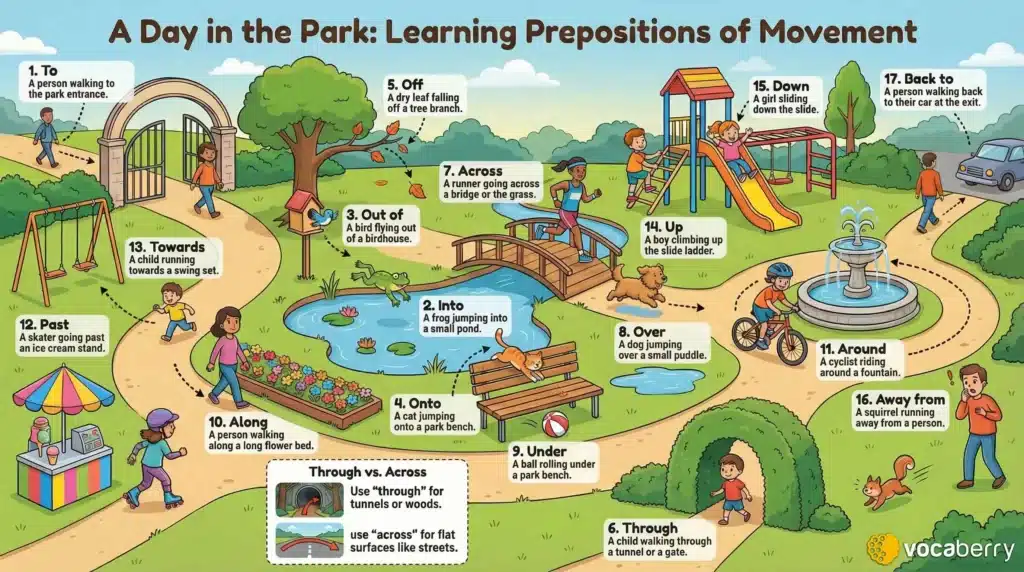
Below are the most common prepositions of movement and how to use them.
1. To
To shows movement toward a destination.
Examples:
- She went to school.
- We are traveling to London.
- He walked to the bus stop.
2. Into
Into shows movement from outside to inside.
Examples:
- She walked into the room.
- The cat jumped into the box.
- He put the keys into his pocket.
3. Out of
Out of shows movement from inside to outside.
Examples:
- He came out of the building.
- The cat jumped out of the box.
- She took her phone out of her bag.
4. Onto
Onto shows movement to a surface.
Examples:
- The cat jumped onto the table.
- He climbed onto the roof.
- She put the book onto the desk.
5. Off
Off shows movement away from a surface.
Examples:
- The cat jumped off the chair.
- He fell off the bike.
- She took the bag off the table.
6. Through
Through shows movement from one side to the other, inside something.
Examples:
- We walked through the park.
- The train went through the tunnel.
- Light came through the window.
7. Across
Across shows movement from one side to the other on a surface or open area.
Examples:
- She ran across the street.
- They walked across the bridge.
- The dog swam across the river.
8. Over
Over shows movement above something, often from one side to the other.
Examples:
- The bird flew over the house.
- He jumped over the wall.
- The plane passed over the city.
9. Under
Under shows movement below something.
Examples:
- The dog ran under the table.
- He crawled under the fence.
- The ball rolled under the car.
10. Along
Along shows movement following a line, path, or surface.
Examples:
- We walked along the beach.
- She ran along the road.
- He cycled along the river.
11. Around
Around shows movement in a circular direction or surrounding something.
Examples:
- They walked around the city.
- The children ran around the playground.
- She looked around the room.
12. Past
Past shows movement beyond a point.
Examples:
- She walked past the store.
- He drove past my house.
- The bus went past the school.
13. Toward / Towards
Toward (American English) / Towards (British English) shows movement in the direction of something.
Examples:
- She walked toward the door.
- The dog ran towards its owner.
- He moved toward the exit.
14. Up
Up shows movement to a higher place.
Examples:
- He walked up the stairs.
- The balloon went up into the sky.
- She climbed up the hill.
15. Down
Down shows movement to a lower place.
Examples:
- He walked down the stairs.
- The ball rolled down the hill.
- She sat down on the chair.
16. Away from
Away from shows movement starting at a place and increasing distance from it.
Examples:
- She walked away from the house.
- The dog ran away from the noise.
- He moved away from the door.
17. Back to
Back to shows movement returning to a place.
Examples:
Prepositions of Movement FAQs
What are prepositions of movement?
Prepositions of movement show how someone or something moves from one place to another. Examples include to, into, across, over, and under.
When do we use prepositions of movement?
We use prepositions of movement with action verbs like go, walk, run, drive, or jump to show direction or change of place.
What is the difference between prepositions of movement and prepositions of place?
Prepositions of place show where something is (static), while prepositions of movement show where something is going (active). For example:
- The cat is in the box.
- The cat jumped into the box.
What are the most common prepositions of movement?
Some of the most common prepositions of movement are to, into, out of, across, along, through, over, under, past, and around.
What is the difference between “into” and “in”?
Into shows movement from outside to inside, while in shows position with no movement.
Example: He walked into the room. / He is in the room.
What is the difference between “onto” and “on”?
Onto shows movement to a surface, while on shows position with no movement.
Example: He put the book onto the table. / The book is on the table.