Words like however, whatever, whichever, whenever, wherever, and whoever all end with -ever, but they are not used in the same way. Each one refers to something different: a person, a thing, a time, a place, a manner, or contrast between ideas. They are very common in everyday English and appear in both spoken and written language.
In this guide, you’ll learn how to use however, whatever, whichever, whenever, wherever, and whoever in English, including their meanings, grammar rules, sentence structure, and clear examples.
However
However is used in two main ways. First, it shows contrast between two ideas and works similarly to “but,” but it is more formal and often used in writing. When used this way, it usually appears at the beginning of a sentence followed by a comma, or after a semicolon in the middle of a sentence. Second, however can mean “no matter how” and is followed by an adjective or adverb to introduce a clause. In this structure, it does not mean “but,” but instead shows that the result does not change even if something varies.
Examples:
- I wanted to attend the meeting. However, I was too busy.
- She trained for months; however, she did not win.
- However hard you try, you cannot control everything.
- However carefully he explains, some people still misunderstand.
Whatever
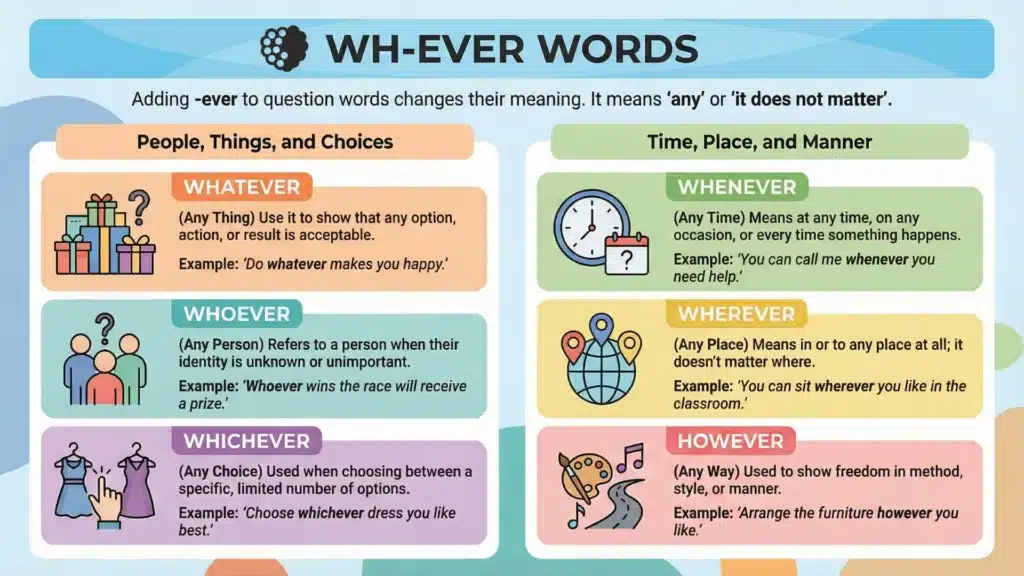
Whatever refers to things or situations and means “anything that” or “no matter what.” It is used when the exact thing is not important or when there is no limitation. It can introduce a clause that functions as the subject or object of a sentence. In informal conversation, it can also express indifference or annoyance.
Examples:
- Eat whatever you like.
- Take whatever you need from the shelf.
- Whatever happens, we will handle it together.
- Whatever she says is usually interesting.
Whichever
Whichever is used when there is a limited or specific set of choices. It means “any one from a particular group.” The difference between whatever and whichever is important: whatever suggests unlimited choice, while whichever refers to a known group of options. It often introduces a clause that depends on a main sentence.
Examples:
- Choose whichever dress you prefer.
- Sit in whichever seat is free.
- Pick whichever option works best for you.
- Take whichever route is faster.
Whenever
Whenever refers to time and means “every time” or “at any time.” It is used when the exact time does not matter or when something happens repeatedly. The meaning depends on the context of the sentence.
Examples:
- Call me whenever you need help.
- Whenever I visit my family, I feel relaxed.
- You can come whenever you are ready.
- Whenever he hears that song, he smiles.
Wherever
Wherever refers to place and means “any place that” or “no matter where.” It is used when the location is not specific or not important. It introduces a clause that shows freedom of place.
Examples:
- Sit wherever you feel comfortable.
- I will follow you wherever you go.
- Wherever she lives, she makes friends easily.
- You can travel wherever you want.
Whoever
Whoever refers to people and means “any person who” or “no matter who.” It is used when the identity of the person is unknown or not important. It can function as the subject or object in a sentence. In very formal English, you may also see whomever, but in everyday English, whoever is often used instead.
Examples:
- Whoever arrives first can start the meeting.
- Give the package to whoever answers the door.
- I will support whoever you choose.
- Whoever made this mistake should explain it.
Comparison Table: Differences Between -Ever Words
This table explains the differences between common -ever words by showing what each one refers to and how it is used in a sentence.
| Word | Refers To | Example Sentence |
|---|---|---|
| However | contrast / manner | However, I disagree with that decision. |
| Whatever | things / situations | You can watch whatever you like tonight. |
| Whichever | limited choices | Choose whichever color matches your room. |
| Whenever | time | Call me whenever you are free. |
| Wherever | place | Sit wherever you feel comfortable. |
| Whoever | people | Whoever finishes first will win the prize. |