In English, we often use have got and has got to talk about possession, relationships, and physical characteristics. These forms are very common in spoken English, especially in British English.
In this lesson, you will learn how to use have got and has got in affirmative, negative, and question forms. You will also learn when to use each one and how they are different from have and has.
What Do “Have Got” and “Has Got” Mean?
Have got and has got mean the same as have and has. We use them to talk about things someone owns or has at the present time, such as family members, physical features, or personal belongings. The difference is mainly about style and usage.
Examples:
- She has got two sisters. (She has two sisters.)
- I have got a car. (I have a car.)
When Do We Use “Have Got” and “Has Got”?
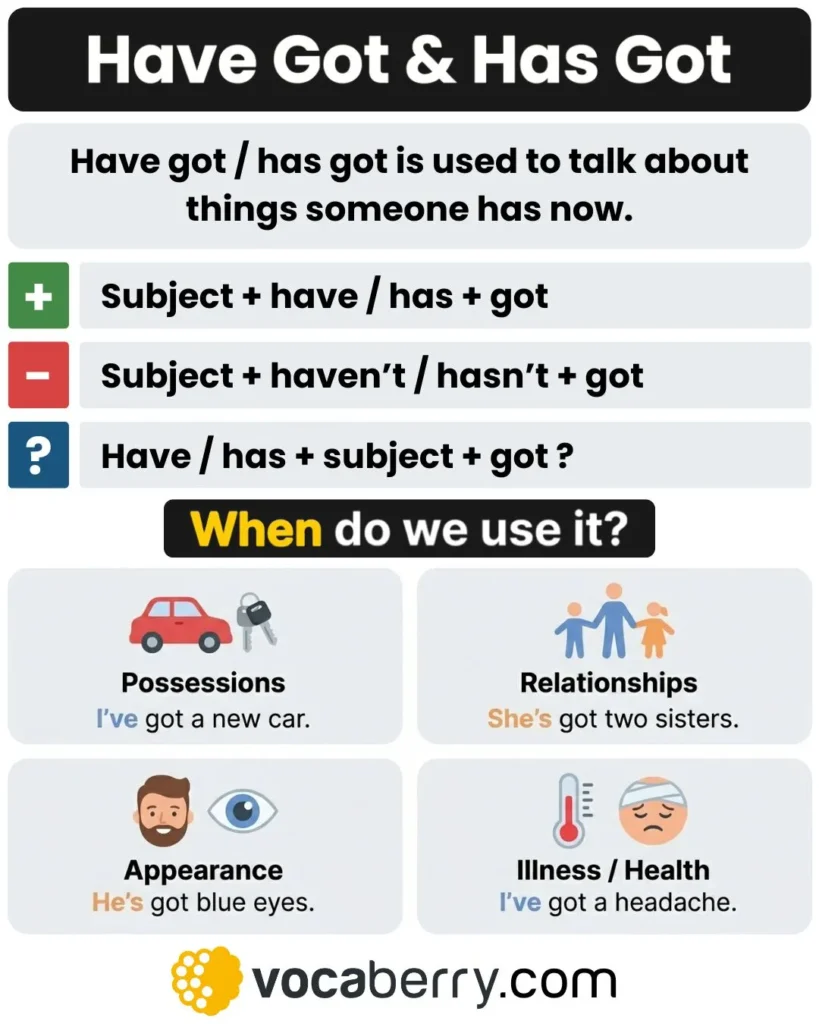
We use have got and has got to talk about things someone has now. This includes possession, family and relationships, physical appearance, and some health problems in informal English. We use this form when we talk about what is true at the present moment.
Examples:
- I have got a phone. (possession)
- He has got a brother. (family)
- She has got long hair. (appearance)
- I have got a headache. (health)
Affirmative Form
We use have got and has got to make affirmative sentences about possession and things someone has now. We often use short forms in everyday English.
| Subject | Full Form | Short Form (Contraction) | Example |
|---|---|---|---|
| I | have got | I’ve got | I‘ve got a car. |
| You | have got | You’ve got | You‘ve got time. |
| We | have got | We’ve got | We‘ve got homework. |
| They | have got | They’ve got | They‘ve got a new car. |
| He | has got | He’s got | He‘s got dark hair. |
| She | has got | She’s got | She‘s got a job. |
| It | has got | It’s got | It‘s got four legs. |
Negative Form
To make the negative form, we use haven’t got or hasn’t got.
| Subject | Full Form | Short Form (Contraction) | Example |
|---|---|---|---|
| I | have not got | haven’t got | I haven’t got enough time. |
| You | have not got | haven’t got | You haven’t got my number. |
| We | have not got | haven’t got | We haven’t got class today. |
| They | have not got | haven’t got | They haven’t got children. |
| He | has not got | hasn’t got | He hasn’t got a job. |
| She | has not got | hasn’t got | She hasn’t got a car. |
| It | has not got | hasn’t got | It hasn’t got a name. |
Question Form
To make questions, we move have or has to the beginning.
| Subject | Full Form | Example |
|---|---|---|
| I | have + subject + got | Have I got the right answer? |
| You | have + subject + got | Have you got a pen? |
| We | have + subject + got | Have we got homework today? |
| They | have + subject + got | Have they got a car? |
| He | has + subject + got | Has he got a job? |
| She | has + subject + got | Has she got a phone? |
| It | has + subject + got | Has it got four legs? |
Short Answers
When someone asks a yes / no question with have got or has got, we answer using have or has. We do not use “got” in short answers.
Examples:
Q: Have you got a pen?
A: Yes, I have. / No, I haven’t.
Q: Has he got a sister?
A: Yes, he has. / No, he hasn’t.
Have Got vs. Have
Both have got and have are correct in English, but they are used in slightly different ways.
Have Got
Have got is very common in spoken English, especially in British English. We mainly use it to talk about possession and things that are true now. It is often used in short form in everyday speech, such as I’ve got and he’s got.
- I’ve got a bike.
Have
Have is used in both spoken and written English and is more common in American English. We use it for possession, but also for actions and routines.
- I have a bike.
- I have breakfast at 8.
When NOT to Use Have Got
Even though have got is very common, there are some situations where we do not use it.
1. Not for the Past
We only use have got in the present. To talk about the past, use had, not had got.
Correct: I had long hair when I was a child.
Incorrect: I had got long hair when I was a child.
2. Not in Continuous (-ing) Forms
We do not use have got with -ing.
Correct: I have got a headache.
Incorrect: I am having got a headache.
3. Not for Actions or Routines
We use have, not have got, for actions, habits, and routines.
Correct: I have breakfast at 8.
Incorrect: I have got breakfast at 8.
Correct: He is having a shower.
Incorrect: He is having got a shower.
Bonus: Have Got To (Obligation)
Have got to is different. It means must or need to, and it is correct.
- I have got to go now.
- You have got to be careful.