Antonyms are words that have opposite meanings. They are common in English and help you express clear contrasts between ideas, actions, and qualities. In this lesson, you’ll learn what antonyms are, see common examples, and understand their main types and how they are formed.
What Are Antonyms?
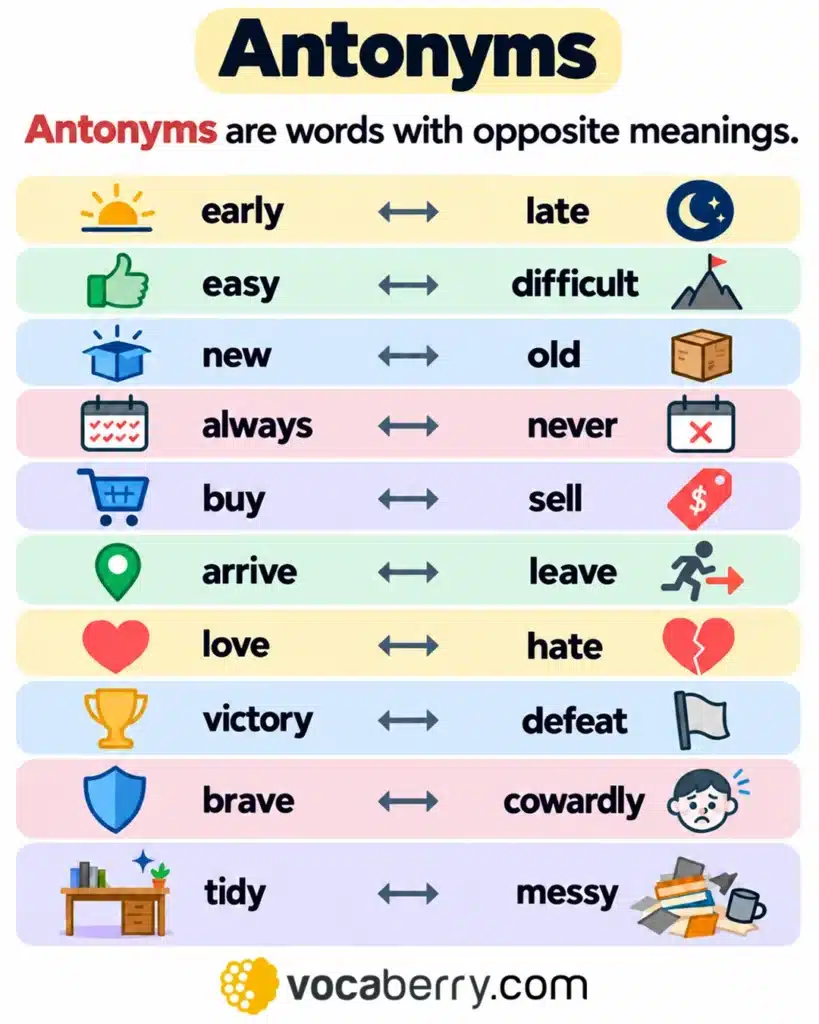
An antonym is a word that has the opposite meaning of another word. For example, hot and cold are antonyms because they describe opposite temperatures. Antonyms are used to show contrast between words, such as opposite qualities, actions, or states.
Examples of Antonyms
Many English words have clear opposites. Antonyms can describe opposite qualities, actions, states, or ideas.
| Word | Antonym |
|---|---|
| big | small |
| early | late |
| easy | difficult |
| empty | full |
| fast | slow |
| happy | sad |
| high | low |
| old | young |
| strong | weak |
| true | false |
| win | lose |
| open | closed |
Types of Antonyms
Antonyms can be grouped into three useful types: gradable antonyms, complementary antonyms, and relational antonyms. Each type shows a different kind of opposite relationship.
Gradable Antonyms
Gradable antonyms describe opposite ends of a scale. There are usually other points between the two opposites.
| Word | Antonym | Between Them |
|---|---|---|
| hot | cold | warm, cool |
| big | small | medium-sized |
| rich | poor | middle-income |
| fast | slow | moderate |
| young | old | middle-aged |
Complementary Antonyms
Complementary antonyms describe two opposite states with no middle option. If one is true, the other is not true.
- alive ↔ dead
- present ↔ absent
- legal ↔ illegal
- true ↔ false
- possible ↔ impossible
Relational Antonyms
Relational antonyms describe the same situation or relationship from opposite sides. One word usually depends on the other for the relationship to exist.
- buy ↔ sell
- give ↔ receive
- lend ↔ borrow
- parent ↔ child
- employer ↔ employee
How to Form Antonyms
Antonyms can be formed in different ways. Some use completely different words, while others are created by adding a negative prefix to a word.
Antonyms with Different Words
Some antonyms are completely different words with opposite meanings.
- happy ↔ sad
- fast ↔ slow
- old ↔ young
- strong ↔ weak
- arrive ↔ leave
Antonyms with Prefixes
Some antonyms are formed by adding a negative prefix to a word. Common prefixes include un-, dis-, in-, im-, il-, and ir-. The prefix changes the word to express an opposite or negative meaning.
| Prefix | Word | Antonym |
|---|---|---|
| un- | happy | unhappy |
| dis- | honest | dishonest |
| in- | correct | incorrect |
| im- | possible | impossible |
| il- | legal | illegal |
| ir- | regular | irregular |
Antonyms and Parts of Speech
Antonyms are usually the same type of word. Nouns, verbs, adjectives, and adverbs can all have antonyms.
Noun Antonyms
Noun antonyms are nouns with opposite meanings.
- success ↔ failure
- friend ↔ enemy
- beginning ↔ end
- victory ↔ defeat
- peace ↔ war
Verb Antonyms
Verb antonyms are verbs with opposite meanings.
- accept ↔ refuse
- arrive ↔ leave
- buy ↔ sell
- give ↔ receive
- remember ↔ forget
Adjective Antonyms
Adjective antonyms are adjectives with opposite meanings.
- easy ↔ difficult
- strong ↔ weak
- clean ↔ dirty
- safe ↔ dangerous
- kind ↔ cruel
Adverb Antonyms
Adverb antonyms are adverbs with opposite meanings.
- quickly ↔ slowly
- early ↔ late
- loudly ↔ quietly
- carefully ↔ carelessly
- always ↔ never
Synonyms vs. Antonyms
Synonyms and antonyms describe different relationships between word meanings. Synonyms connect words with the same or similar meanings, while antonyms connect words with opposite meanings. A single word can have both synonyms and antonyms, depending on the meaning you want to express.
| Word | Synonyms | Antonyms |
|---|---|---|
| happy | glad, cheerful | sad, unhappy |
| big | large, huge | small, tiny |
| easy | simple, straightforward | difficult, hard |
| fast | quick, rapid | slow, sluggish |
| quiet | silent, peaceful | loud, noisy |
| strong | powerful, tough | weak, fragile |