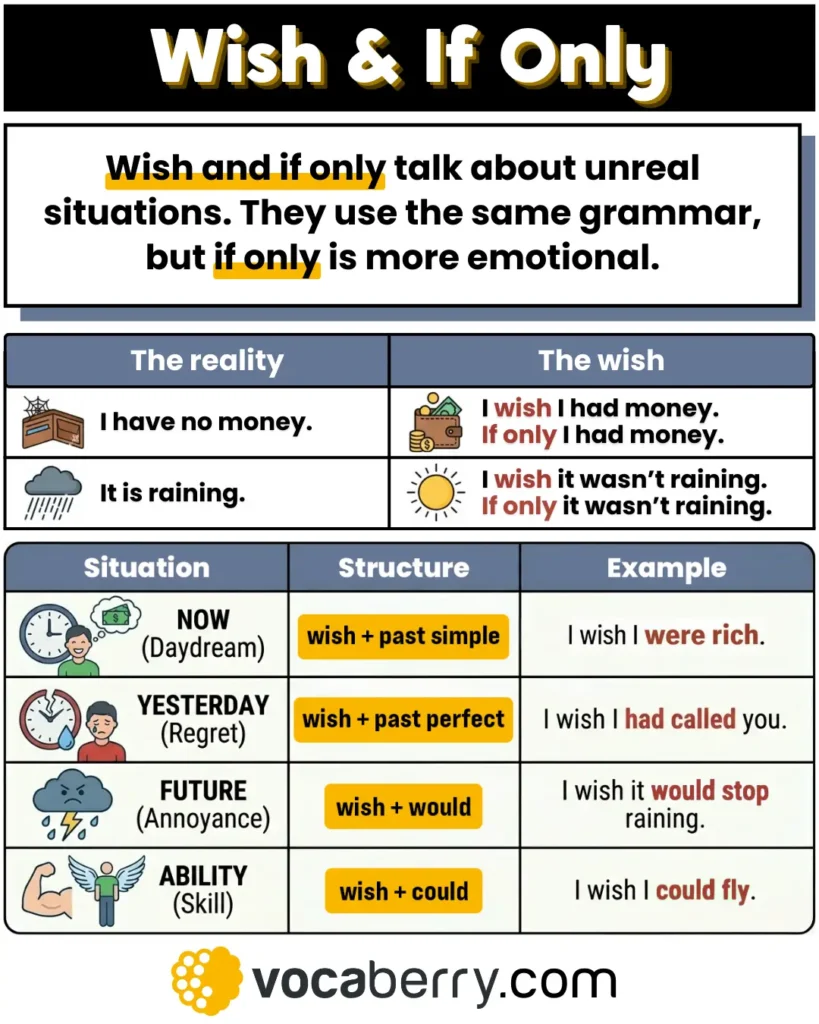
In English, we use wish and if only to talk about situations we want to be different. These sentences often show regret, disappointment, or strong desire about the present, the past, or the future.
In this article, you will learn how to use wish and if only, the difference between them, and how to form sentences for the present, past, and future, with clear examples.
What Do Wish and If Only Mean?
Wish and if only are used to say that reality is different from what we want. We use them when we are unhappy with a situation or when something is impossible, unlikely, or not true right now.
They often talk about things we cannot change easily, especially about the present or the past.
Examples:
- I wish I had more time.
- If only it were easier.
Difference Between Wish and If Only
Wish and if only follow the same grammar rules. We use them in the same sentence structures. The difference is not grammar, but feeling.
Wish is neutral and common. It sounds normal and calm.
If only is stronger and more emotional. It often shows deeper regret, sadness, or frustration.
Examples:
- I wish I had an umbrella. (I want one.)
- If only I had an umbrella! (I really, really need one right now!)
Using Wish and If Only for the Present
We use wish and if only to talk about a situation that is not true now, but we want it to be different. The situation is unreal or imaginary.
Even though we are talking about the present, we use the past simple form. The past form here does not show past time. It shows that the situation is not real.
Structure: wish / if only + past simple
Examples:
- I wish I knew the answer.
- If only she worked here.
- He wishes he had more money.
- If only it was warmer today.
Using Wish and If Only for the Past
We use wish and if only to talk about regrets about the past. The situation already happened and cannot be changed. We are unhappy about something that happened before.
To talk about past regrets, we use the past perfect form.
Structure: wish / if only + had + past participle
Examples:
- I wish I had studied more.
- If only we had left earlier.
- She wishes she hadn’t said that.
- If only they had told me the truth.
Using Wish and If Only for the Future
We use wish and if only to talk about situations we want to change in the future. This form is often used when we feel annoyed, impatient, or unhappy. It is usually used to talk about other people or things, not ourselves, and it often sounds like a complaint.
Structure: wish / if only + would + base verb
Examples:
- I wish you would listen to me.
- If only it would stop raining.
- She wishes her boss would be nicer.
- I wish the bus would come soon.
Using Wish and If Only with Could
We use could with wish and if only to talk about ability, possibility, or opportunity. We use this form for present abilities and past opportunities that did not happen.
Present structure: wish / if only + could + base verb
- I wish I could speak English fluently.
- If only we could travel more.
Past structure: wish / if only + could have + past participle
- I wish I could have helped you.
- If only I could have gone with them.
Using “Were” After Wish and If Only
When we use wish or if only to talk about the present, we often use were instead of was. This helps show that the situation is unreal or not true right now.
This is most common with I, he, she, and it. In everyday spoken English, many people use was, but were is more correct and is preferred in writing and exams.
Structure:
wish / if only + subject + were
Examples:
- I wish I were rich.
- If only I were taller.
- She wishes she were more confident.
- If only it were warmer today.
Wish vs. Hope
Learners often confuse wish and hope, but they are used differently.
We use wish when we talk about something that is not real, not true now, or unlikely to change.
We use hope when we talk about something that is real, possible, or likely to happen.
- I hope I pass the exam. (possible)
- I wish I were taller. (not possible)
Summary Table
| Situation | Structure | Example |
|---|---|---|
| Present | wish / if only + past simple | I wish I had more time. |
| Past | wish / if only + past perfect | I wish I had studied more. |
| Future | wish / if only + would | I wish you would call me. |
| Ability | wish / if only + could | I wish I could fly. |
Wish and If Only – FAQs
What is the difference between “wish” and “if only”?
There is no difference in grammar between wish and if only. Both are used in the same way, but if only sounds stronger and more emotional than wish.
What tense do we use after “wish” for the present?
To talk about the present, we use the past simple after wish. This shows that the situation is not true now. For example: I wish I had more time.
What tense do we use after “wish” for the past?
To talk about the past, we use the past perfect after wish. This shows regret about something that already happened. For example: I wish I had studied harder.
Can we use “wish” to talk about the future?
Yes, we can use wish with would to talk about the future when we want something to change. This is common when we feel annoyed or impatient. For example: I wish it would stop raining.
What is the difference between “wish” and “hope”?
Wish is used for unreal or impossible situations, while hope is used for real and possible situations. For example: I wish I were taller (unreal), but I hope I pass the exam (possible).
Can we say “I wish I was” or “I wish I were”?
Both are used in modern English, but I wish I were is more grammatically correct, especially in formal English. I wish I was is common in spoken English.